Risk management software for ISMS & GRC
Know which risk matters. And who needs to act.
Assessing a threat does not mean you have treated the risk. Kopexa connects your risk register with business processes, assets, suppliers and tasks. Your team can explain its priorities, put treatment into action and keep residual risks in view.
Priorities you can explain
Assess likelihood and consequence using a shared method.
Action beyond the register
Bring risks, treatment measures and responsible people together.
Assessments that stay current
See review intervals and the next review on each risk.
Our customers

















Make informed decisions
Which risk needs your attention first?
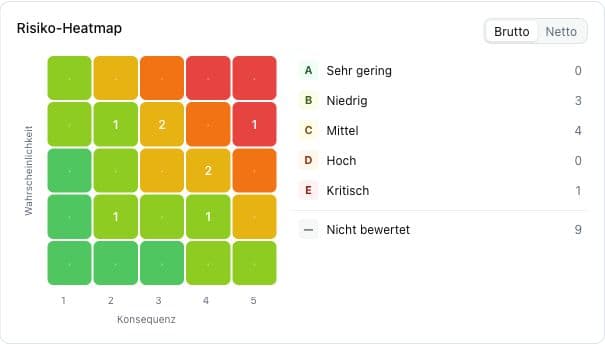
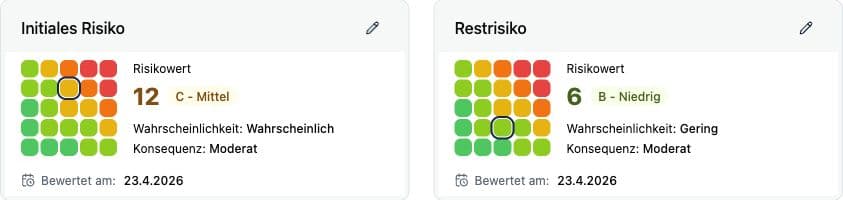
Assess likelihood and consequence in the 5×5 risk matrix. Initial and residual risk remain visible separately, so you can explain your assessment before and after treatment. The register's heatmap helps you prioritise the assessments across your risks.
From assessment to action
A treatment plan needs someone to carry it out.
Decide whether to mitigate, accept, transfer or avoid a risk, and record your rationale. Link appropriate measures and tasks directly to the risk. Comments on the risk keep questions and discussion in context. Owners and deadlines take the decision into everyday work without maintaining a separate task list alongside it.
Manage tasks in context- 01
Assess
Assess the initial risk and determine its priority.
- 02
Treat
Explain the strategy, link measures and assign tasks.
- 03
Review
Assess residual risk and schedule the next review.
Business risks in context
More than a red cell. A business operation at risk.
A supplier outage affects more than IT. Link risks to processes, assets, suppliers and information assets. Documents, controls, incidents, stakeholders and objectives add context. Business teams and information security can discuss the same risk picture.

Keep going after approval
Is this assessment still current? Keep asking.
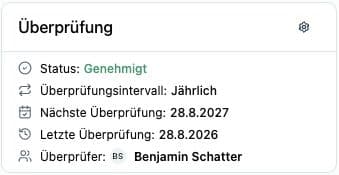
Approving an assessment and reviewing it regularly serve different purposes. Kopexa shows its status, reviewers, interval, last review and next review on the risk. Automatic reminders help prompt reassessment on time. An approved risk remains part of your ongoing work.
Start with a foundation
You do not need to write every risk from scratch.
Use relevant entries from the risk catalog and add your own risks. Categories help organise information security, cloud, people, supplier and operational risks. Set the assessment and treatment for your actual business context.
When does risk management software make sense instead of Excel?
A spreadsheet can be a useful starting point for a small scope. Once several people maintain risks, track treatment and review assessments regularly, their connections matter. Check whether the software connects this work:
- Can you understand the initial risk, residual risk and treatment decision?
- Are owners, measures and tasks linked directly to the risk?
- Can you connect affected processes, assets and suppliers?
- Do reviewers, intervals and due reviews stay visible?
Risk management within your ISMS and wider GRC work.
Use the same risks in the context of your programmes and controls. Kopexa supports work on ISO 27001, NIS2 and other frameworks. The assessments and evidence you need depend on your scope and the applicable requirements.
Questions about risk management software
What does risk management software do?
Risk management software helps teams record risks, assess them using a shared method, document treatment decisions and track implementation. Kopexa connects the risk register, initial and residual assessments, owners, linked measures and tasks, and regular reviews.
What is the difference between initial and residual risk?
Initial risk describes the assessment before the treatment being considered. Residual risk is the remaining assessment after that treatment. Kopexa displays both separately with likelihood, consequence and a risk score. A lower score does not replace checking whether the measures are effective.
Is Kopexa only for information security risks?
No. You can also record operational, people and supplier risks. Connections to business processes, assets, information assets, suppliers and objectives help you consider risks in their business context. Risk management is part of the GRC platform and can also be used within an ISMS.
How do risk assessments stay current?
You can set regular risk reviews with an interval and reviewers. Status, the last review and the next review are visible on the risk. Automatic reminders support ongoing maintenance; your team carries out the reassessment and makes the decision.
Can I connect measures and tasks directly to risks?
Yes. Kopexa supports linked measures and tasks on a risk, keeping assessment, treatment strategy and implementation in the same context. Owners and deadlines support collaboration across the team.
Bring a risk. We will show you the path to action.
See how your team assesses risks, assigns responsibility and keeps the next review in view in a live demo.
See risk management in action