Fehmarnbelt cyber incident: Can your business work without central IT?
The incident at tunnel contractor FLC raises a continuity question. Review time-critical processes, fallback procedures and recovery priorities.

IT is working on the outage. But who decides how the business continues in the meantime? The incident at the Fehmarnbelt tunnel contractor makes this question tangible in our region. It also matters to manufacturers, logistics providers and businesses whose orders depend on a central system.
TL;DR: Restore work, not just systems
- Start with the process: Which work can be interrupted, and for how long?
- Understand dependencies: Which systems, people, data and suppliers does it need?
- Check fallback procedures: Can a safe alternative actually work without central IT?
- Follow through: Give each exercise finding an owner, deadline and another check.
What is known about the Fehmarnbelt incident
On October 13, Femern A/S confirmed that contractor Femern Link Contractors (FLC) had reported a cyber incident. On October 14, NDR reported disrupted site workflows and temporarily non-functioning access cards.
This concerns a construction contractor, not traffic through an operational tunnel. The short project statement does not establish a specific attack vector. We do not treat attacker attribution as confirmed either.
The difference: IT available or work possible?
An accessible server is a technical result. Whether a business team can work also depends on data, access, approvals, people and other services.
Consider our fictional review scenario: a logistics company cannot use its order software. Paper forms are ready, but delivery addresses and contacts exist only in the unavailable system. The form exists. The fallback process still does not work.
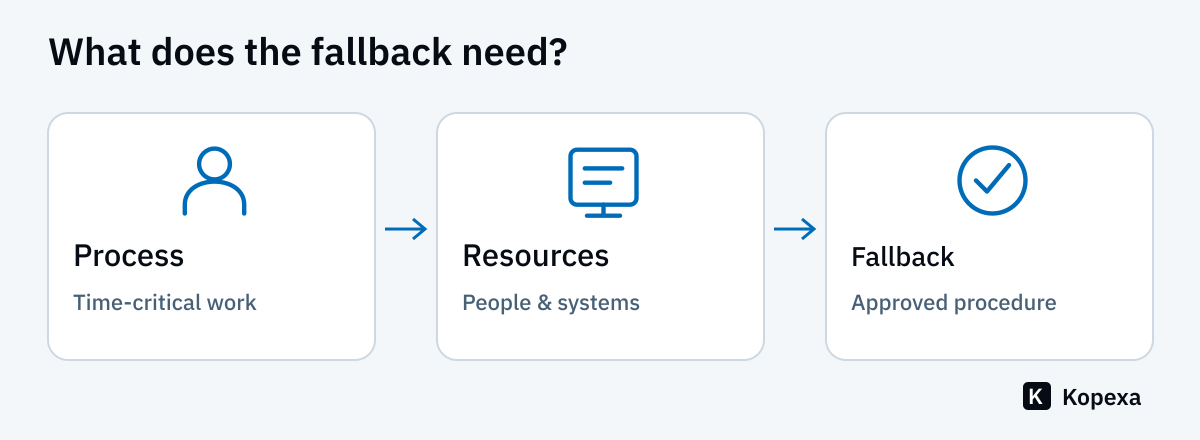
Fictional review scenario: a plan matters when people can use it to do their work.
BSI Standard 200-4 distinguishes resumption, business continuity in emergency operation and restoration. Identify a reduced, viable workflow and its prerequisites. Full normal operations are a separate objective.
Five questions for your next process review
Choose one time-critical business process. This is our working template, not an account of FLC’s organisation.
| Review question | What a useful answer contains |
|---|---|
| How long can work stop? | Impact over time and a justified priority |
| What must continue? | Specific activities and an acceptable service level |
| Which resources does the fallback need? | People, information, tools, access and partners |
| Who authorises the switch? | Decision owner, deputy and reachable contacts |
| How do you return safely? | Review criteria, data reconciliation and approval |
A Business Impact Analysis examines impacts and time priorities. Record the supporting systems in a maintained asset inventory and assess external dependencies through supplier risk management.
A service should not be restored first merely because its server is the largest. The sequence needs to reflect the business and its dependencies.
A tabletop exercise that reveals gaps
Use this fictional starting point: Central IT is unavailable. The next order still needs to be handled.
Walk through one order. Who receives it? Where does reliable information come from? Who approves decisions? How do staff and partners learn which procedure applies?
A fictional order and a discussion are enough for the first run. Do not shut down production systems for it. Fallback procedures involving site access, machinery or other safety-critical activities require specialist review and approval. Improvised continuity must not introduce further harm.
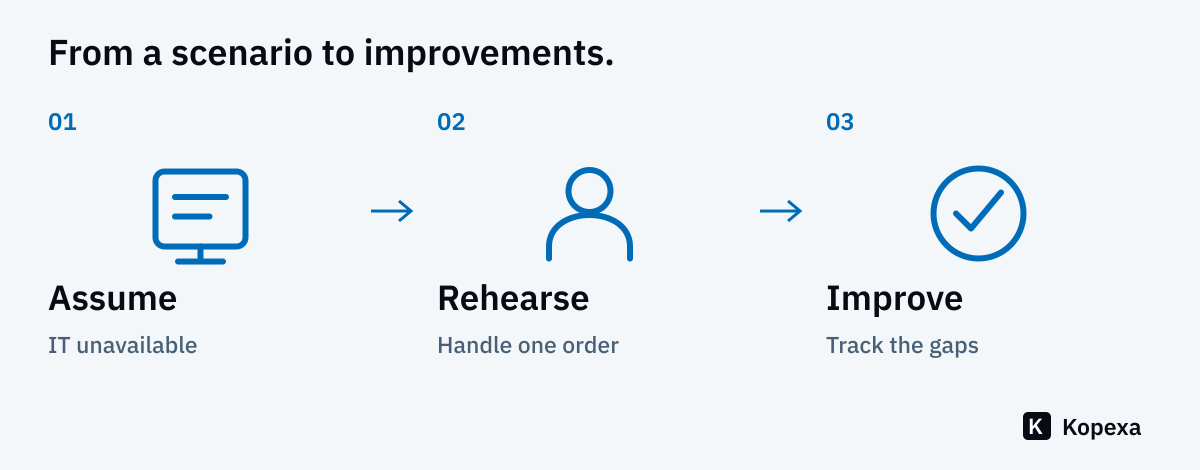
Our working model: turn the exercise into verifiable improvements.
A required contact stored only in the unavailable directory is a concrete finding. Two teams each expecting the other to make a decision is another. Record the gaps and exercise the revised procedure again. Our article on reporting routes and exercises explains preparation and evaluation.
Make continuity part of ongoing management
An emergency plan loses value when systems, contacts and suppliers change without a review of the consequences. Link processes to resources, risks and owners. Keep actions and exercise evidence connected to them.
Kopexa supports this work with processes, BIA, assets, suppliers, risks, tasks and evidence. This helps your team bring priorities and open work together. Specialist review and exercises still establish whether a fallback actually works.
Your next step: Choose one important process. Ask not only whether a plan exists, but whether you can safely handle the next order using it. For an actual suspicion, see our separate incident management guide.
Quick answers
Frequently Asked Questions
Still have a question? Find the answers here.
Is a working backup enough for emergency operations?
No. A backup supports data restoration. Emergency operations also need people, information, access, tools and an approved workflow. Check whether a specific activity can actually be performed with them.
How do IT restoration and business continuity differ?
IT restoration brings technical resources back. Business continuity describes how time-critical work can continue during disruption using a viable fallback. Coordinate both tasks.
How can we start an exercise without disrupting operations?
Walk through a fictional order without central IT in a tabletop exercise. Check information, ownership, approvals and contacts. Leave production systems running; technical or safety-related tests need agreed scope and approvals.