Meta’s GitHub data breach: How far can a stolen account reach?
Stolen credentials opened Meta’s GitHub repositories. What businesses should check across access rights, secrets, test data and incident response.

A private repository sounds like a protected space. Yet “private” only describes who is allowed inside. The important question is: What could someone reach after taking over one of those accounts? The Meta incident is a reason to rehearse that question in your own business.
TL;DR: Three things to check
- Limit reach: Which repositories and integrations can one account access?
- Control contents: Do access keys or real personal data belong in your development projects?
- Prepare the response: Who blocks access, replaces affected secrets and checks potential consequences?
What is known about Meta
According to the October 14 CybersecurityNews report, attackers used stolen employee credentials to access Meta repositories on GitHub. They took code and personal information; roughly 1,500 people are being notified. Meta said the personal data had been stored there against internal policy and that its internal systems were not breached.
The reports do not explain how the credentials were stolen or the role of MFA. They therefore do not establish a particular MFA failure.
“Private” does not describe an account’s reach
For your own review, treat the repository as a business asset. It has a purpose, an owner, sensitive contents and connections to other systems.
A developer account may reach several projects. Automations may introduce additional permissions. Configuration files, test data and older commits may contain information nobody expects in the current source code. Your inventory needs to establish which of these possibilities actually applies.
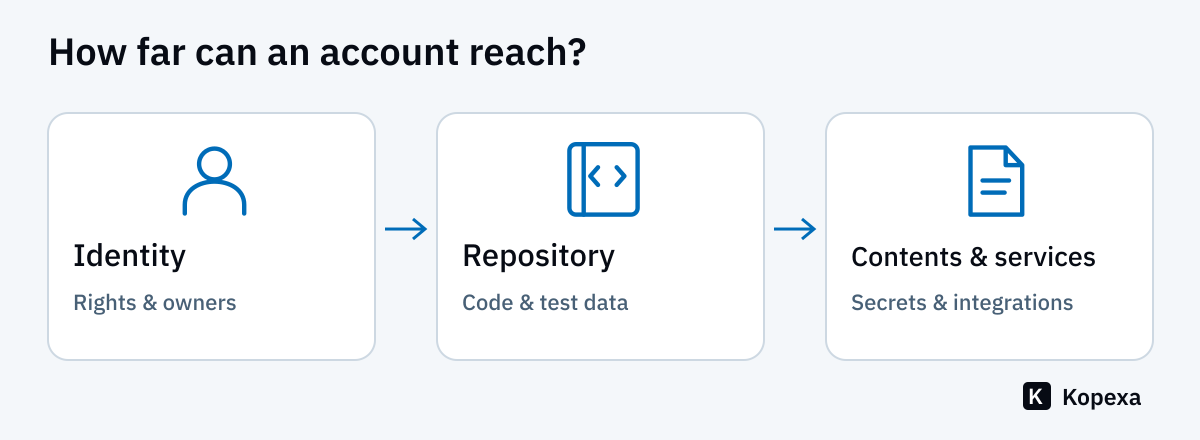
Review model for your environment: consider identity, repository and connected systems together.
This view helps you find the responsible teams without starting from scratch during an incident. You can identify potentially affected business processes and decision owners. Our ISMS guide explains how to put these dependencies into context.
Three controls that belong together
1. Identities: Who needs which access?
Review employees, external developers, technical accounts and installed applications. Separate personal accounts from automations and limit permissions to the required scope. Reviews should include role changes and departed service providers.
GitHub’s authentication documentation describes different access methods. Asking whether MFA is enabled is therefore not enough: include tokens, SSH keys and the actual permissions of integrations in your review.
Useful evidence: A reviewed access list with a date, an owner and decisions about permissions that are no longer needed.
2. Contents: Test data needs an explicit decision
“Only for testing” should not become an ownerless exception. Define which data may be used in development and how test data is produced. Renaming a production extract does not make it harmless.
Include previous versions, attachments and sample files. Secret scanning and checks for unwanted personal information address different problems. An API-key scanner does not replace a test-data review.
Useful evidence: A documented data rule, a reviewed test-data creation process and resolved scan findings.
3. Secrets: Deleting is not revoking
A clean new commit alone does not remediate an exposed key. GitHub recommends revoking affected secrets with their provider. Repository cleanup is another step; it does not disable existing copies.
Coordinate replacement with teams whose services use the key. Verify that affected applications work and that the old credential is invalid. Preserve relevant logs and assess suspicious use.
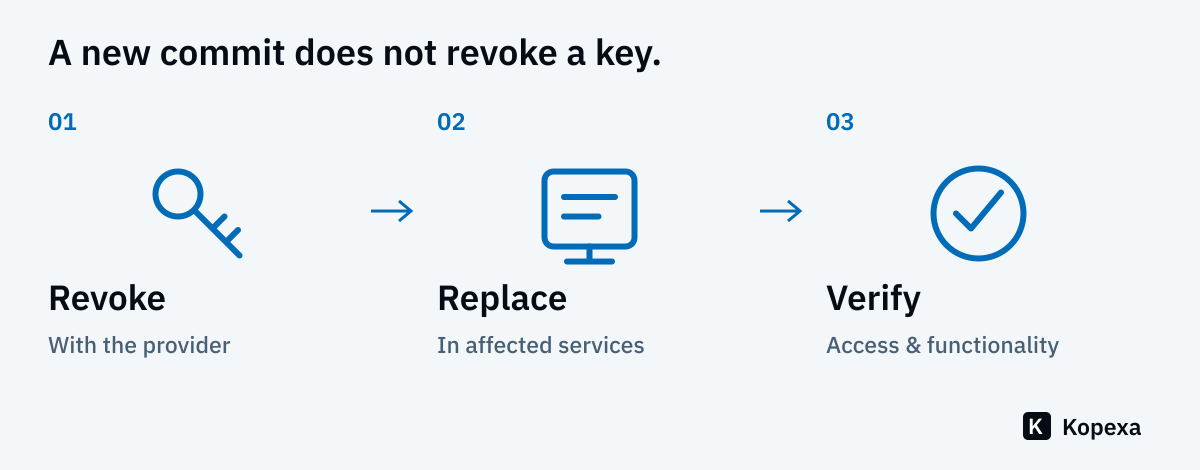
A closed alert becomes a meaningful conclusion when the remediation has been verified.
From a technical finding to completed work
A finding needs more than a chat message. Use this working template to bring IT and security owners together:
| Review question | Establish ownership | Record the result |
|---|---|---|
| Which projects can the account reach? | Repository owner and IT | Scope and required permissions |
| Which data belongs there? | Business team and privacy team | Data rule and reviewed test data |
| Which services use the secret? | Service owners | Replacement plan and functional check |
| Has the old access been blocked? | Identity or platform team | Revocation and verification |
| What should improve after the incident? | Security owners | Tracked improvements |
Kopexa helps coordinate this work through assets, risks, tasks and evidence. The practical value is keeping open work linked to its owners. The responsible teams perform technical revocation and key replacement in the relevant systems.
A useful exercise starts with one account
You do not need to recreate a major attack. Start with this scenario: “An external developer reports that their account has been taken over.” Discuss which access you would block, which information you could preserve and who decides the next step.
Agree an explicit scope for any technical test; a fictional account is enough for an initial tabletop exercise. Our article on reporting routes and incident exercises explains how to make it useful. For a real suspicion, see the incident management guide.
Your next step: Choose one important repository. Review its access, data and integrations together. Give each gap an owner, a deadline and a verifiable conclusion.
Quick answers
Frequently Asked Questions
Still have a question? Find the answers here.
Does a private GitHub repository automatically make its data safe?
No. Private repositories still need appropriate permissions, protected identities and rules for their contents. A compromised authorised account may still reach the data.
Is deleting an exposed API key from the code enough?
No. Revoke the key with its provider and replace it if needed. Then check affected services and possible unauthorised use; a new commit does not disable the old key.
What should a developer-account takeover exercise test?
Review reporting routes, responsible teams, reachable repositories and integrations, revocation and affected secrets. Use a fictional account for a tabletop exercise; technical tests require an agreed scope.