ISO 27001 vs. TISAX: Differences, Requirements and Costs
ISO 27001 or TISAX? Compare requirements, assessment levels and costs. Build on your existing ISMS and plan the next steps without duplicating work.

At a glance: ISO 27001 or TISAX?
A customer requires TISAX? An ISO 27001 certificate does not automatically replace that requirement. If you already have an ISMS, build on it. The remaining work depends on the requested assessment objective and the relevant scope.
- ISO 27001 is a cross-industry standard for an information security management system (ISMS).
- TISAX provides assessment and exchange of information security results in the automotive ecosystem.
- Need both? Coordinate the shared security work while checking each framework's requirements separately.
Updated: 13 October 2026. Based on official ISO and ENX information. The decision guide and practical examples are our interpretation.
ISO 27001 vs. TISAX: key differences
Start the ISO 27001 vs. TISAX comparison with the evidence your customer needs. A certificate and a TISAX result are different outcomes.
| Question | ISO 27001 | TISAX |
|---|---|---|
| Purpose | An ISMS across industries | Assessment and exchange of results in the automotive ecosystem |
| Basis | ISO/IEC 27001 | ISA requirements and the TISAX process |
| Outcome | Certificate following successful certification | Assessment result with corresponding labels |
| First scope question | Which ISMS scope should be certified? | Which objectives, sites and labels does the partner require? |
See the official ISO 27001 overview and ENX's explanation of ISA.
For a starting point, read our ISO 27001 catalogue and ISMS guide.
When do you need ISO 27001, TISAX or both?
These situations are examples, rather than universal recommendations for an industry.
A new automotive customer requires TISAX
Confirm the required label, the relevant contract and the deadline first. Identify the sites and services involved. “We need TISAX” is not yet a complete project brief.
Is TISAX mandatory for automotive suppliers? It is not a general legal obligation for every supplier. A business partner can make it a condition of cooperation. ENX describes such requirements in its TISAX FAQs.
You already have ISO 27001 and now need TISAX
Start with your existing system. Check whether its certified scope covers the relevant services and sites. Then compare your implementation with the required ISA criteria. A gap analysis shows what you can reuse and where work remains.
You serve customers across industries
Record each customer's requirements. One automotive contract may require TISAX while another customer requests an ISO 27001 certificate. Decide based on that demand, your risks and your resources. A second form of evidence should not require a second organisation.
Our ISO 27001 certification guide explains the certification journey.
Understanding TISAX requirements and assessment levels
The assessment level defines the assessment method, not the project duration. AL2 checks the plausibility of your self-assessment using evidence and an interview. AL3 verifies fulfilment more comprehensively and includes on-site activities. AL1 results are not used in the TISAX exchange. Source: ENX Participant Handbook.
Ask your partner for the specific assessment objective, rather than just “Level 3”. For your project, also establish:
- Which customer information do you handle?
- Which sites, teams and service providers are involved?
- Are additional requirements, such as prototype protection, relevant?
- Who provides evidence, closes gaps and follows up on deadlines?
Plan the path from your current position to assessment. A higher assessment level does not automatically mean several years of implementation. Equally, a short preparation period does not prove that the implementation is sound.
Planning ISO 27001 and TISAX costs
A useful estimate starts with your scope and outstanding gaps. A universal price range without these details offers little help with a budget decision.
| Cost component | Questions to resolve before requesting a quote |
|---|---|
| Internal work | Owners, available hours, sites and existing evidence |
| Implementation | Missing processes, technical measures and training |
| External support | Which work can you do yourself, and where do you need advice? |
| Certification or assessment | Scope, assessment method and possible follow-up assessments |
| Platform and ongoing operation | Licence, onboarding, reviews and evidence maintenance |
For TISAX certification costs (more precisely, TISAX assessment costs), distinguish registration from assessment. ENX calculates registration fees using the sites included in scopes; the audit provider offers the assessment. Source: ENX registration and fee FAQs.
Our TISAX costs and process guide helps with planning. Obtain comparable quotes for the same scope. Include internal effort when comparing ISO 27001 costs with TISAX costs.
How long does implementation take?
Build a plan from outstanding measures, their owners and available capacity. An existing policy is a start; putting processes into practice and gathering reliable evidence also takes time. Use that plan to agree an assessment date.
Reusing work: a practical example
Example: An external IT provider has remote access to a system containing customer data. The team needs to know who has access, why it is needed and when it ends.
Keep the work connected:
- Record the context: Identify the provider, affected asset and business process.
- Assess the risk: What happens if access is misused or the service fails?
- Implement the measure: Assign an owner, restrict permissions and schedule a review.
- Check the evidence: Record approval and the reviewed permissions.
- Map the requirements: Check which specific ISO 27001 and ISA requirements this addresses and what else is needed.
Mapping requires professional judgement. A similar topic does not mean an identical requirement. The same evidence may be insufficient for a different scope or depth of assessment.
This is the GRC connection: customer requirements, risks, suppliers and tasks are part of the same work. Information security cannot be achieved simply by maintaining two checklists.
Keeping control as more requirements arrive
Kopexa lets you manage multiple programmes and connect the work with risks, tasks and evidence. You can see who owns an outstanding measure and which evidence is missing. Professional judgement and external assessment remain necessary.
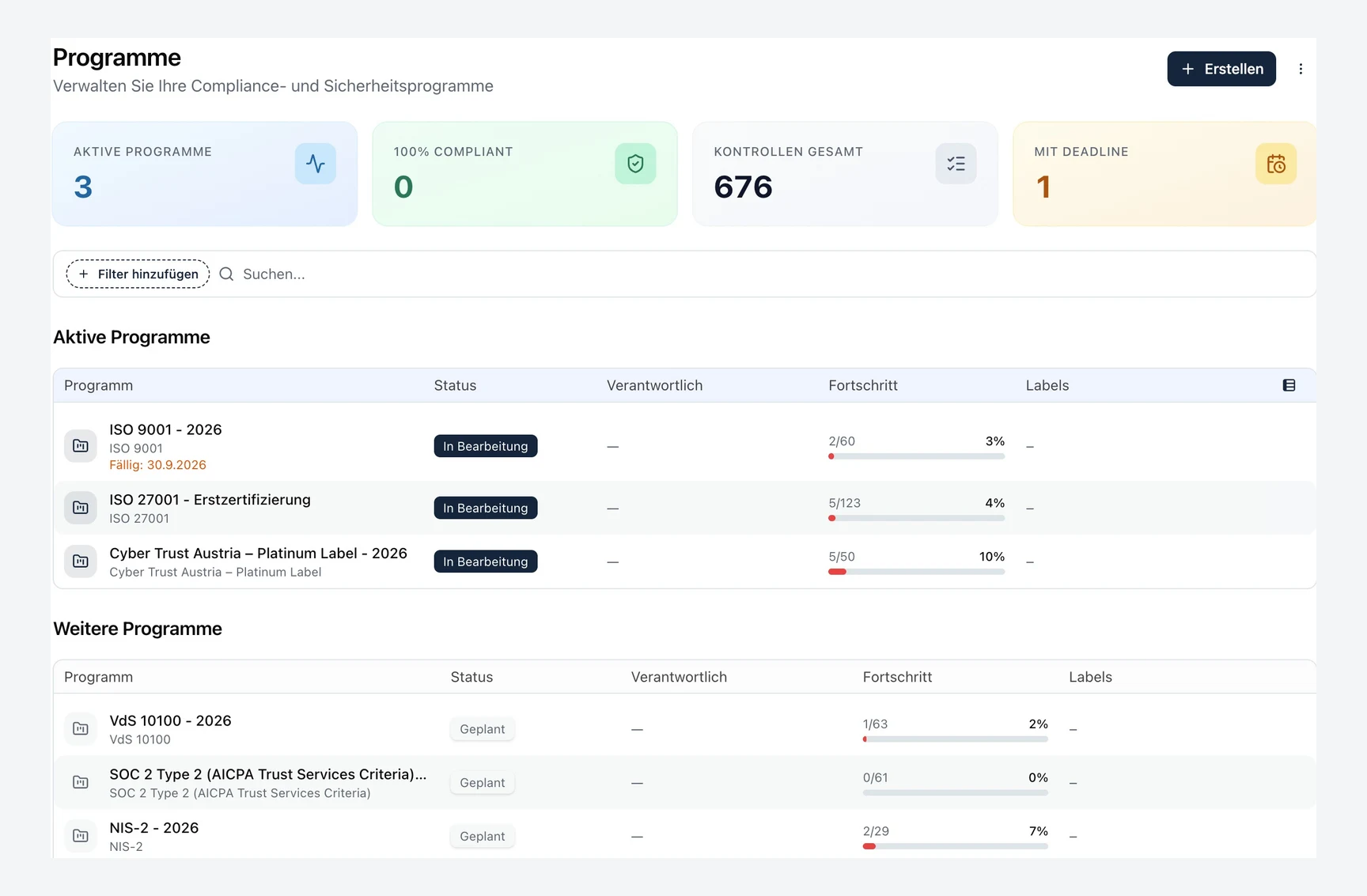
The product view shows multiple programmes with example data. The displayed progress is not an audit result.
An existing ISMS provides a foundation. The next step is to bring its content into the workflow, make gaps visible and assign the next task clearly. Our ISMS software provides an entry point into the broader GRC platform.
Evaluating benefits and ROI
Measure time spent finding evidence, overdue measures and questions raised before assessment. Compare the same scope before and after implementation. Include licensing, onboarding and ongoing maintenance. This supports an accountable evaluation, rather than a universal ROI guarantee.
Treat avoided cyber losses as scenarios with assumptions, rather than savings already achieved. Recheck your scope when customers, sites or catalogue versions change.
Your next step
Before deciding, write down the required evidence, the relevant scope and your biggest outstanding gap. This gives you a basis for comparing quotes and prioritising the project.
Want to see how ISO 27001 and TISAX connect with your existing work? Explore Kopexa in a demo. Bring your starting point: an existing ISMS, a new customer requirement or several programmes.
Quick answers
Frequently Asked Questions
Still have a question? Find the answers here.
How much does ISO 27001 certification cost?
Costs depend on scope, sites and the maturity of your ISMS. Budget internal work, implementation, external support and certification separately. Compare quotes for the same scope and include ongoing operation.
Is TISAX mandatory for automotive suppliers?
It is not a general legal obligation for every supplier. A customer can make TISAX a condition of cooperation. Confirm the required label, scope and deadline with your business partner.
What ROI does ISO 27001 deliver?
There is no universal ROI guarantee. Compare time spent finding evidence and preparing for assessment before and after implementation. Set measured benefits against the full costs. Avoided losses are scenarios based on assumptions.
How long does ISO 27001 implementation take compared to TISAX?
A universal duration is unreliable. Existing processes, outstanding gaps, scope and available capacity determine the plan. The TISAX assessment level describes the assessment method, not implementation time.
Can companies benefit from combining both standards?
Yes, by reusing shared security work while reviewing each requirement professionally. Risks, ownership and evidence can be coordinated. Whether evidence is sufficient depends on scope and the specific requirement; this does not establish a fixed savings percentage.
Which standard is better suited for non-automotive companies?
ISO 27001 is designed for use across industries. Customer requirements still determine the choice: an IT provider outside vehicle manufacturing may need TISAX for an automotive contract.
Does an ISO 27001 certificate replace a TISAX assessment?
Not automatically. Check the customer requirement and compare your existing ISMS with the relevant ISA criteria. An existing certificate provides a foundation but does not replace the requested TISAX result.
Is TISAX a certification?
TISAX certification is a commonly used phrase. Formally, it is an assessment with a result and corresponding labels within the TISAX process. Distinguish this evidence from ISO 27001 certification.
Sources
- ISO: ISO/IEC 27001:2022 [Accessed ]
- ENX: ISA [Accessed ]
- ENX: TISAX FAQs [Accessed ]
- ENX: TISAX Participant Handbook [Accessed ]