Dealership data breach: supplier assurance needs more than a certificate
The GeNesys breach highlights digital supply-chain risk. How to check TISAX scope, current evidence and operational information security.

The invoice number is correct. So is the purchase price. The sender even knows when your new car is due. Those details make the GeNesys car dealership software data breach consequential: real transaction information can lend credibility to a fraudulent payment request.
For businesses, the broader question is: How well do we understand the service providers behind our operations, including their suppliers? Collecting an assurance document does not answer that on its own.
What is known about the dealership data breach
Dealer Kuhn+Witte publicly describes unauthorised access in September 2026 to GeNesys, operated by Achter Autohaus Software GmbH. Customer, invoice and vehicle records are among the data categories mentioned. Its notice warns about potential deceptive payment requests.
The 14 October dpa report cites police describing entry through third-party software with a serious vulnerability. The overall extent remained open. A risk of fraud is reported, not an established nationwide fraud campaign.
For buyers: independently confirm bank-account changes with the dealership using contact details you already trust, rather than details supplied in a suspicious message.
Supply-chain risk extends beyond the contracted provider
A dealership buys a software service. That service depends on further components, operational processes and access paths. Customer information consequently relies on decisions made outside the dealership.
Our assessment: the relevant supply chain extends beyond parts installed in vehicles. Sales platforms, hosting, remote maintenance and technical interfaces also belong in the risk review. What matters is the information and business activity accessible through them.
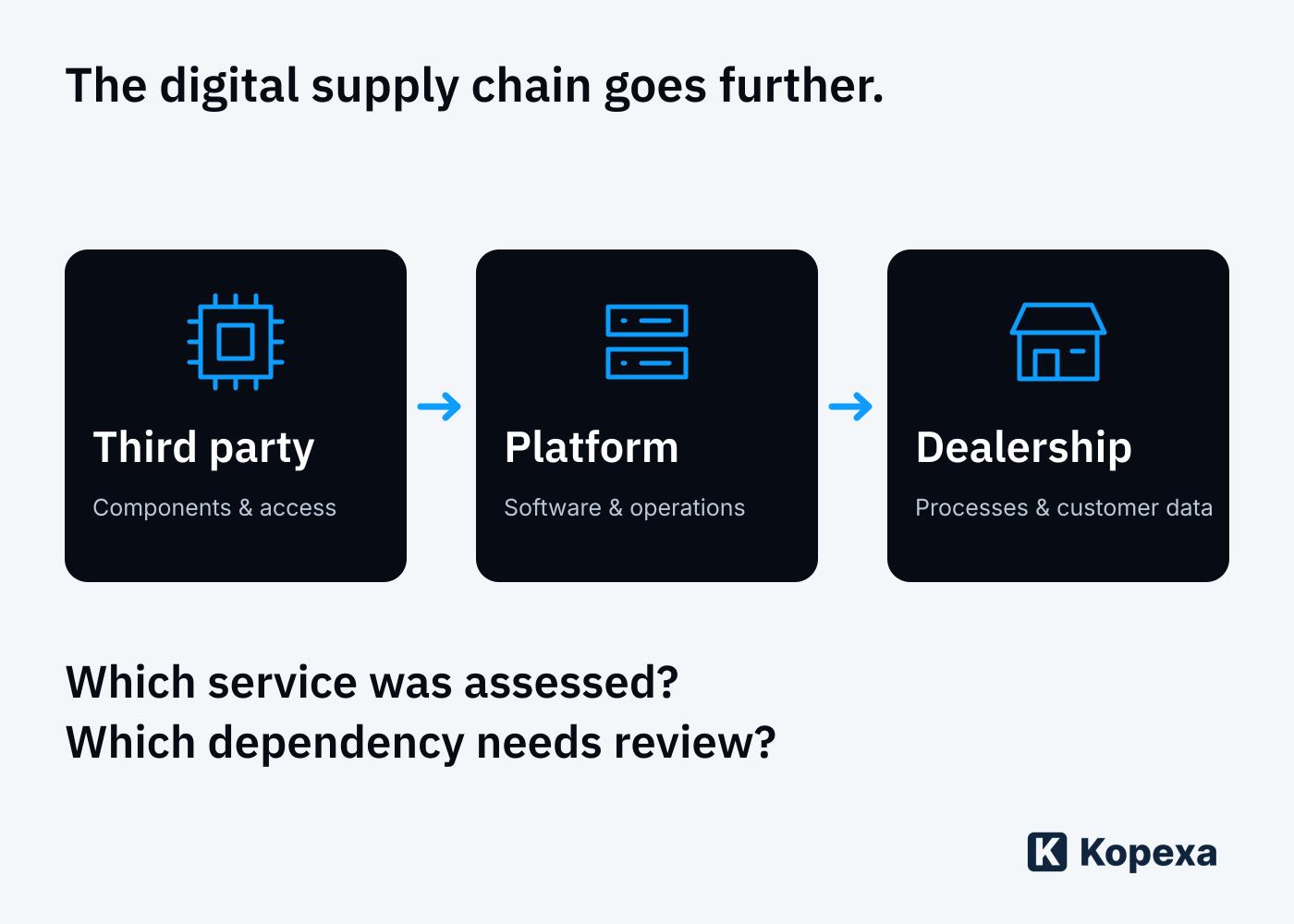
A supplier register becomes useful for decisions when it connects the purchased service, its data and its dependencies. A company name alone is insufficient. Our supplier risk management guide covers the overall approach; this incident provides a concrete reason to ask again.
TISAX: what was assessed, and does it cover our service?
TISAX results provide meaningful assurance in the automotive industry. Their relevance depends on the business relationship. The ENX participant handbook distinguishes assessment scope, locations and objectives. Labels are generally valid for three years; significant changes can affect scope or validity.
A general reference to an assessment does not establish whether it covers the service you actually purchase. Similarly, an ISO 27001 review needs the certified scope. A website logo cannot replace that connection.
The incident sources reviewed here do not establish whether the organisations involved held these forms of assurance or what their scope covered. This TISAX discussion is our interpretation for supplier reviews, not a claim about their assessment status.
The important questions come after the document
For critical providers, our recommendation is to connect assurance to your actual operations and request suitable current evidence.
| Review question | What a useful answer provides |
|---|---|
| Does the scope cover the service and relevant locations? | A traceable connection between the contract, service and assessed scope. |
| Is the assurance current and verifiable? | Shared TISAX status in the ENX portal; for certificates, issuer, scope and validity. |
| How are critical vulnerabilities handled? | Responsibilities, agreed response times and recent evidence of handling a relevant advisory. |
| Which subcontractors and access paths are involved? | Service-specific dependencies and permitted access. |
| How are incidents and significant changes communicated? | Named contacts, an agreed reporting route and results from checks or exercises. |
The stronger question is: “Show us how you do that today.” A generic yes in a questionnaire is not yet evidence of effectiveness.
A supplier survey needs to lead to action
A useful assessment ends in a reasoned approval, a tracked action or a conscious risk decision. Missing evidence needs an owner and a follow-up date.
With Kopexa, teams can record suppliers and dependencies, send surveys automatically and use reminders to follow up. The Survey Engine derives risk ratings from answers using your configurable rules. Your team reviews responses, requests evidence and connects open findings with tasks and risks. The review becomes a traceable workflow instead of a collection of separate inbox threads.
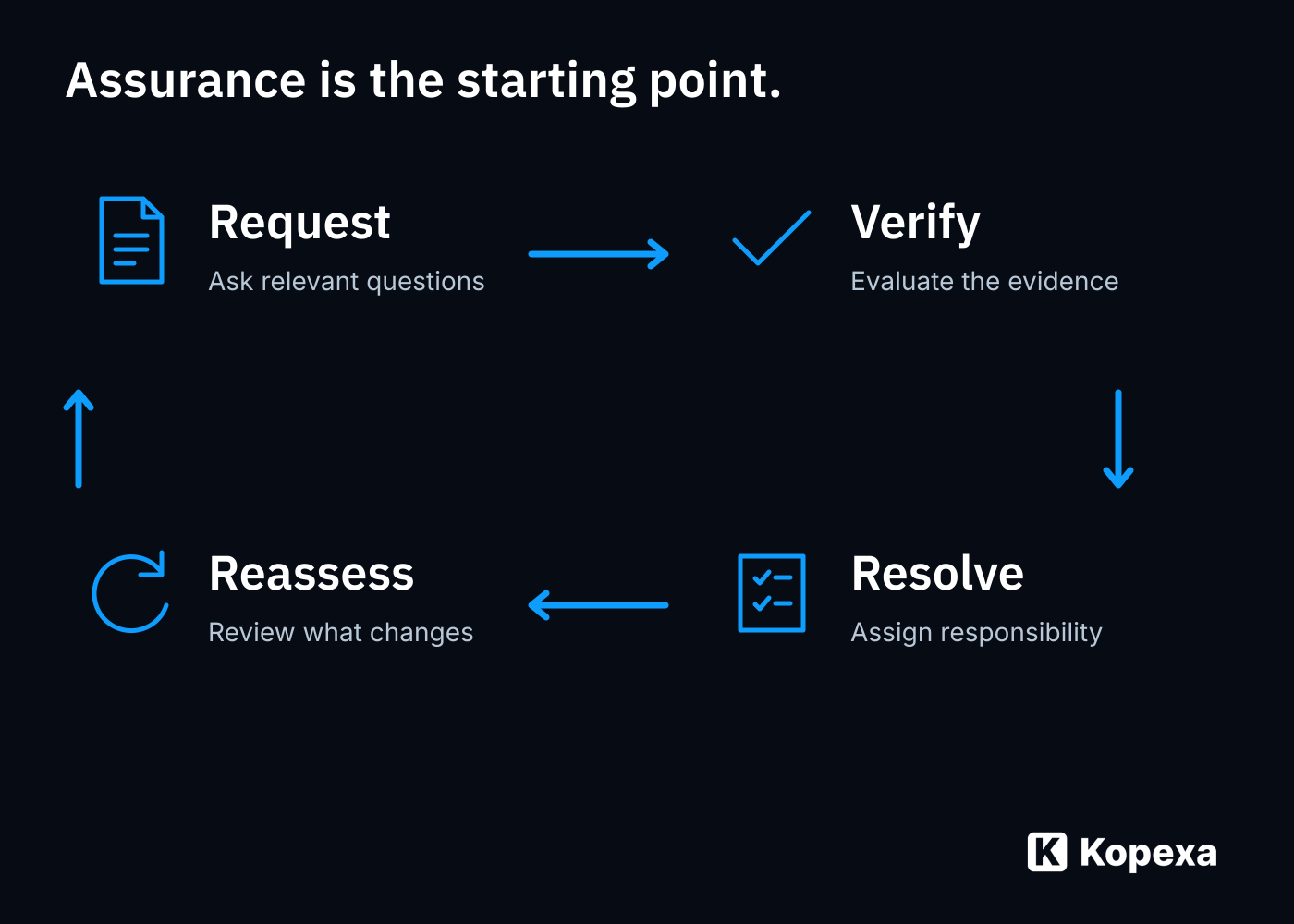
Automation handles repeated coordination. Professional judgement remains necessary. Neither a questionnaire nor a certificate guarantees that a supplier will avoid a security incident.
See our automated vendor assessment workflow and the industry context on TISAX and ISMS for automotive suppliers.
One practical next step
Pick one business-critical software provider. Can you explain today which service was assessed, what it depends on and when you last verified implementation?
If the answer is simply “We filed the certificate”, the supplier review is still open. Assurance should prompt more precise questions.
Title image: AI-generated illustrative dealership scene, not an affected business. Design and original diagrams: Kopexa. Sources last checked on 19 October 2026.