Measure · ISO 27001 and other standards
Approve and follow through supplier services
Take an external service through selection, agreement, use and exit. Reuse existing supplier assessments and keep decisions and open work together in the existing procurement or service record.
Reuse existing records
Reuse your supplier records, contracts and existing risk method. The assessment workbook helps when a suitable questionnaire is missing. The joint supplier and cloud policy sets the process without creating a second assessment or a mandatory form for every review.
What to do
- 1
Define the service and appropriate checks
Describe the purpose, information, access and consequences of failure in the existing record. Name the responsible person. Use your risk method and existing assessment to select the questions, evidence and checks needed. For a certificate, compare validity, scope and covered services with your use. Record open questions.
- 2
Decide on terms and use
Compare the required security services with the contract or proposed standard terms. Address protection, incident contacts and assistance, relevant subcontractors, changes, suitable evidence and the end of the service. For ICT products, also consider critical components, origin, integrity and support. Use suitable manufacturer information or risk-based checks. The authorised role decides on use and outstanding conditions. Internal approval does not override applicable obligations.
- 3
Assign and carry out cloud tasks
For the service actually used, record which tasks belong to the provider and which belong to you. Name internal owners for the remaining configuration, access, monitoring, backup, recovery and incident assistance. Check, for example, who creates backups and who tests that they can be restored. Carry out your tasks under your existing access and operating rules. Buying the service does not complete them.
- 4
Carry out reviews, changes and exit
In the same record, define who checks which agreed service and evidence, and when. Evaluate results and follow through corrections. Also review relevant changes, such as a new subcontractor, data location or end of support, to identify necessary changes to risk, contract and approval. At exit, prepare handover or export and the continued usability of required data. Carry out agreed deletion and the separate removal of access, then check the result. Record justified retention and outstanding evidence.
Worked example
Example: A cloud service changes its subcontractor
An approved cloud service announces a new subcontractor and a different processing location. The existing service record holds the assessment and contract.
- Review the change
- DecisionThe responsible person identifies the affected data and agreed terms. They assess the change with the relevant security and privacy roles.
- EvidenceThe announcement, affected service and evaluated contractual or risk consequences are linked to the service record.
- Decide on continued use
- DecisionThe authorised role decides on continued use and necessary changes to safeguards or the contract. Open points receive an owner.
- EvidenceThe decision refers to the evaluated change and the current agreement.
- Follow through the result
- DecisionThe responsible person checks whether the agreed changes were implemented. If continued use is unacceptable, they carry out the prepared export and exit with the provider and IT.
- EvidenceThe review result and completed follow-up work remain in the existing record. A necessary exit is closed with the handover, end of access and deletion status.
Record the result
- The existing supplier or service record connects the service, responsibility, assessment and reasoned use decision with the current agreement.
- For cloud services, provider and customer tasks, their actual execution and suitable review results are traceable. Critical ICT dependencies and relevant subcontractors remain connected.
- Ongoing reviews show evaluated results, changes and actual follow-up work. At the end of the service, handover, deletion and access status, and any outstanding retention or evidence, are traceable.
Common implementation mistakes
Treating a certificate as approval
Check whether it covers the purchased service and your use. Resolve remaining risks and open conditions before the authorised role decides on use.
Confusing provider tasks with your own tasks
A provider backup does not tell you who can restore your data, or in what form. Clarify the specific split and check your remaining tasks.
Creating a new list for every review
Keep results and follow-up work in the existing service record. A new register or an on-site audit for every supplier is not a universal requirement.
Reuse the implementation across requirements
The references below show which requirements the measure contributes to.
View controls and standards
- A.5.19 · Informationssicherheit in LieferantenbeziehungenGerman guide
Sections 1 and 2 connect the specific service, responsibility, risk-based assessment and approval in the existing record. Actual assessment and decisions must be made for your own services.
- A.5.20 · Berücksichtigung der Informationssicherheit in LieferantenvereinbarungenGerman guide
Section 3 supports appropriate security agreements and traceable deviation decisions. Actual agreement, legal review and implementation remain necessary.
- A.5.21 · Management der Informationssicherheit in der IKT-LieferketteGerman guide
Section 3 includes relevant ICT subcontractors, critical components, integrity and support in selection and agreements. Real supply-chain information and suitable evidence still need to be obtained and evaluated.
- A.5.22 · Überwachung, Überprüfung und Änderungsmanagement von LieferantendienstleistungenGerman guide
Section 5 connects regular and change-triggered service reviews with change decisions and corrections in the existing record. Reviews, evaluation and follow-up work must actually be carried out.
- A.5.23 · Informationssicherheit bei Nutzung von Cloud-DienstenGerman guide
Sections 4 and 5 support the cloud lifecycle through specific task allocation, your own use, reviews, changes and exit. They do not prove actual configuration or implementation.
TISAX · 6.1.1
VDA ISA 6.0.3 · Partial overlap
The joint workflow supports risk-based selection and assessment of security-relevant services, suitable agreements and review of contractors and partners. Actual assessments, completed agreements, review results and applicable additional requirements remain to be evidenced. This is not a separate cloud ISA crosswalk or a claim to full objective fulfilment.
Reference
Templates for your implementation
Template
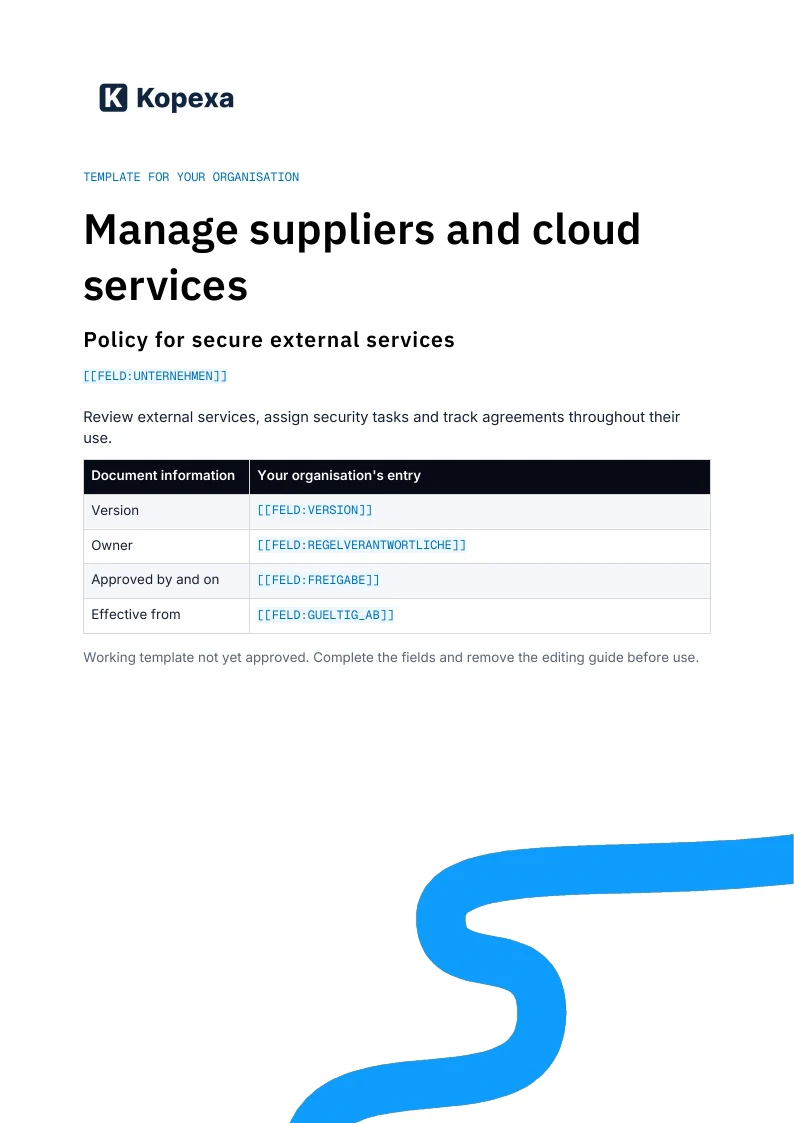
Joint supplier and cloud policy
Reuse existing supplier assessments and contracts. The policy connects decisions, security terms and reviews without creating another supplier questionnaire.
Free ZIP · DOCX, ODT and PDF · editing instructions included
Template
Supplier assessment with an Excel template
Rate vendors against weighted criteria. You set the weights and limits yourself.
Guide & Excel template · email required
Template
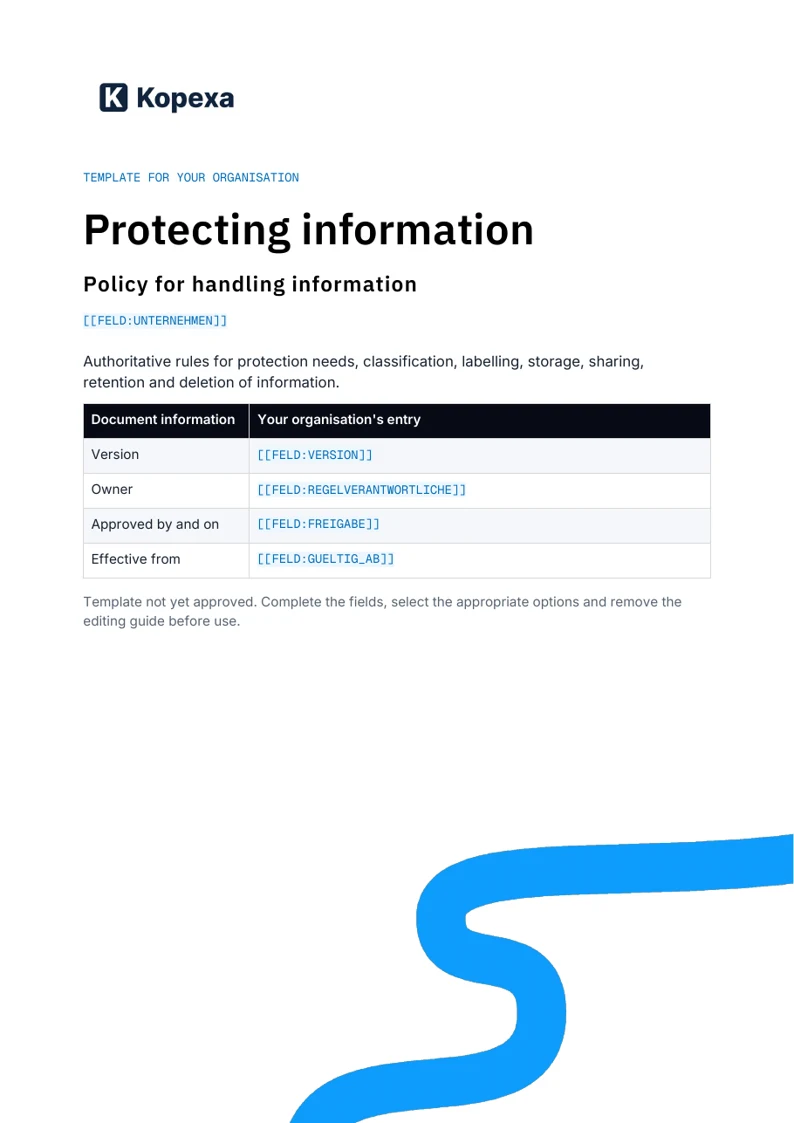
Use authoritative information protection rules
One policy for information classes, labelling and handling. With fields and an example classification scheme to adapt to your organisation.
Free ZIP · DOCX, ODT and PDF · with editing instructions
Template
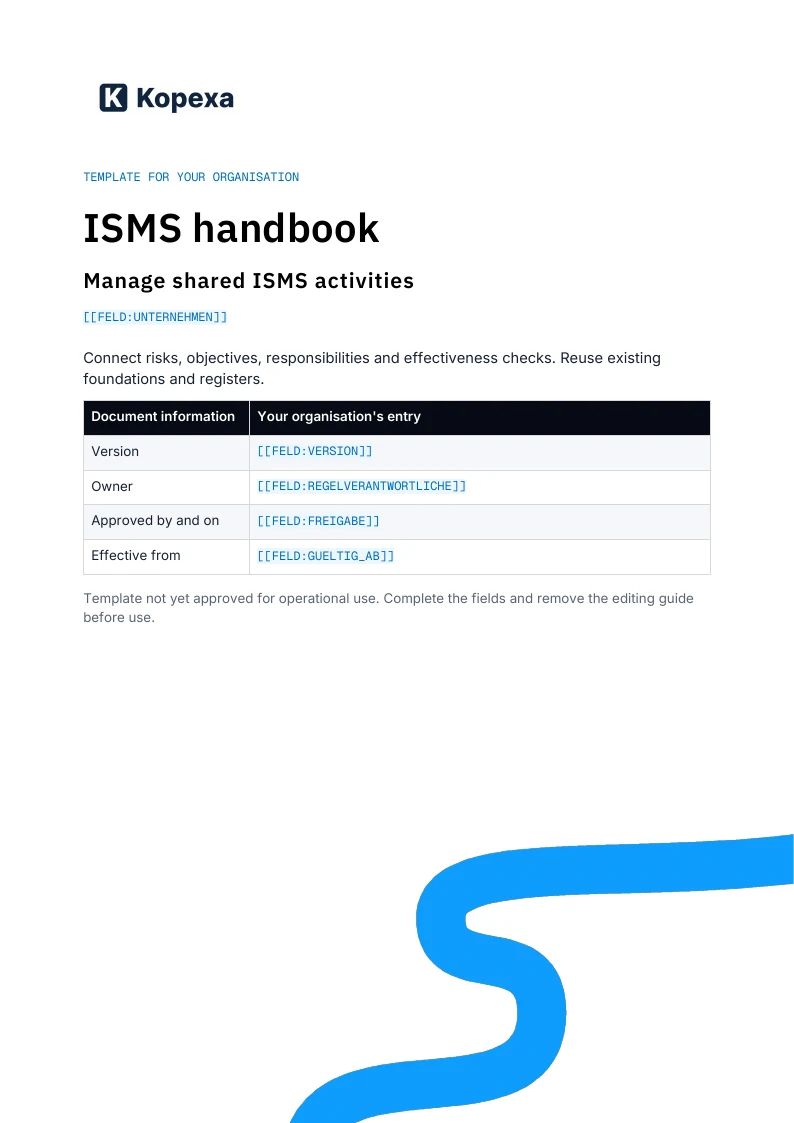
Connect the existing risk method and decisions
Reuse your existing scope, policy and registers. The handbook connects management processes and identifies the decisions and evidence your organisation supplies.
Free ZIP · DOCX, ODT and PDF · with editing instructions

Related resources
Kopexa
Manage suppliers and reviews in KopexaExplore featureConnect suppliers and subcontractors with assessments, risks, documents and follow-up work.