Guide
Best GRC software for corporate groups in 2026
Compare GRC software for corporate groups: test tenant separation, shared controls, local exceptions and consolidated reporting in practice.
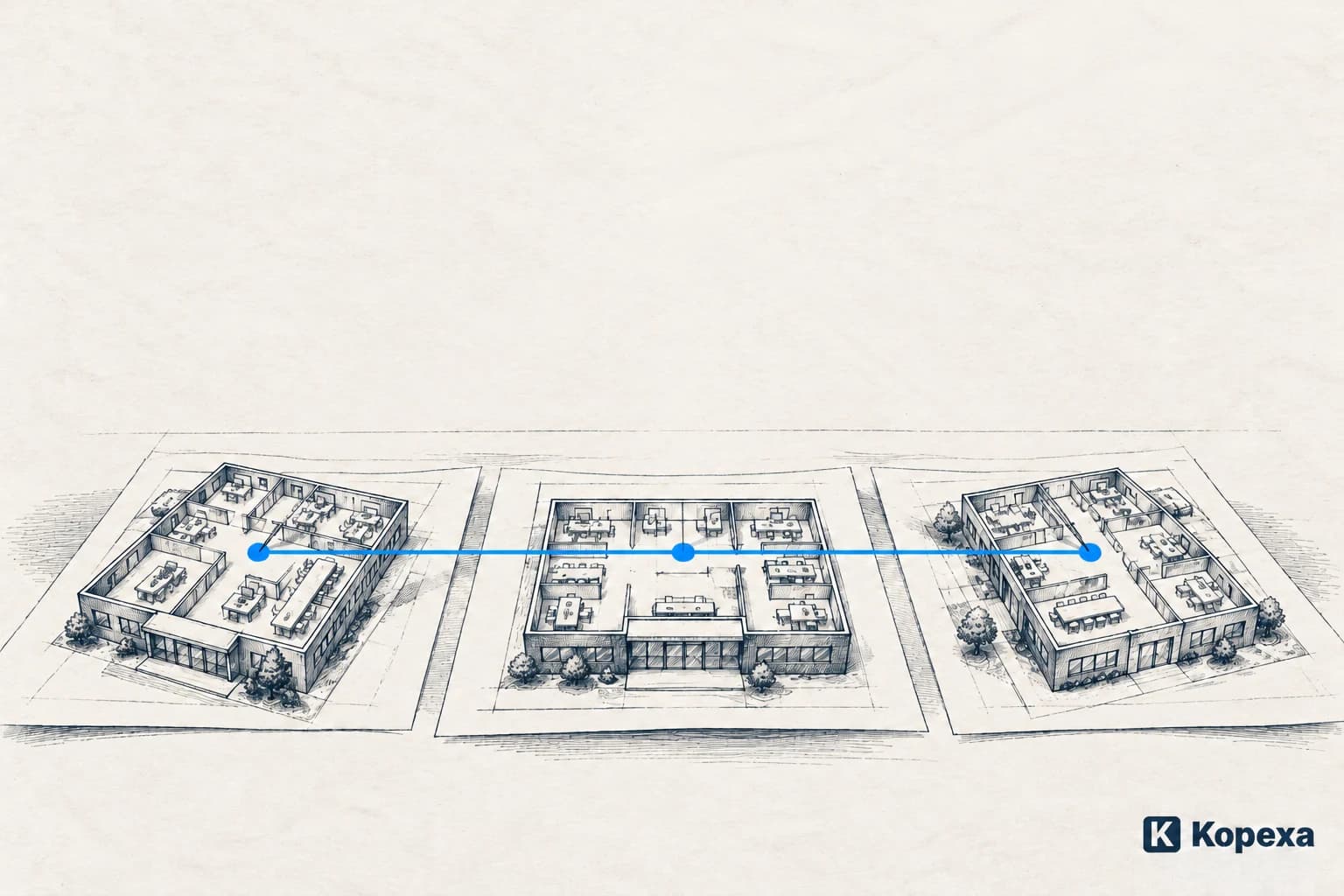

For a corporate group, the best GRC software makes shared elements useful while keeping differences visible. Multiple tenants alone do not solve this. Separate responsibilities, controlled reuse and meaningful group reports are decisive.
Kopexa is our own product. This article is a selection aid based on public manufacturer information from 22 October 2026, not an independent laboratory test. The solutions form a limited shortlist.
Start with your governance model
First define what is decided centrally and what remains locally owned. A shared identity service, an independent production environment and a newly acquired subsidiary pose different requirements.
Our guide to GRC for subsidiaries separates central requirements from local implementation. You can then assess whether a product supports your structure.
These criteria determine suitability
| Criterion | Practical test question |
|---|---|
| Access boundaries | Does a local role see only the data intended for it? |
| Shared basis | How is a central requirement adopted and maintained locally? |
| Exceptions | Do the reasoning, decision and review date for a deviation remain visible? |
| Consolidation | Can the group recognise different scopes and missing responses? |
| Changes | What happens when a company joins or is sold? |
| Data portability | Can the required information for one entity be exported traceably? |
Treat access separation as mandatory. A high overall score elsewhere must not compensate for failing it.
Three approaches to investigate
Vanta describes Workspaces for multiple business units, with separate content and integrations plus a group-wide view. Its documentation notes that an upgrade or add-on may be required. Check actual availability and consolidation scope in the offer. Product page, documentation
HiScout describes a shared database across GRC modules, tenant management and adaptable workflows. Ask for specific permissions and data adoption paths to be demonstrated against your organisational structure. HiScout GRC Suite
Kopexa offers custom frameworks and connections between measures, evidence and controls. For a corporate group, test how your scopes, roles and central requirements work together in the specific configuration. We do not claim a particular group-wide aggregation function here without testing it.
These differing descriptions do not imply that other products lack particular functions.
Test with two deliberately different subsidiaries
Fictional test case: Company A uses the central backup service. Company B also has a local application. The central recovery test does not cover that application.
A suitable test shows whether both entities can use the same central evidence without incorrectly portraying B as fully protected. Then change the central requirement. Check who is notified and which local assessment is retained.
This tests evidence reuse and its limits together.
Include implementation and future change
Ask about costs and effort for additional companies, separate administrators, local frameworks and changes to the organisational model. Have the provider show which data survives splitting or merging entities.
An export test belongs in selection here too. Document the methodology required: comparable reports need comparable assessments.
Decide using your test record
Keep mandatory criteria, observed behaviour and unresolved promises separate. A roadmap feature is not an available solution today. Recheck the decisive points before signing.
During a guided Kopexa trial, you can work through the group case using sanitised data. For subsequent governance, the result should remain traceable through to the management decision.
Quick answers
Frequently Asked Questions
Still have a question? Find the answers here.
Is an additional tenant for each subsidiary enough?
Not necessarily. You also need to test shared services, local exceptions, access boundaries and the path into group reporting.
How do I test a consolidated report?
Use two subsidiaries with deliberately different implementation states. Check whether the report keeps missing data, different scopes and local gaps visible.
Sources
- Vanta Workspaces — Vanta [Accessed ]
- Vanta Workspaces documentation — Vanta [Accessed ]
- HiScout GRC Suite — HiScout [Accessed ]