Guide
Sensitive data: GDPR categories, examples and practical safeguards
Identify special category data under GDPR, distinguish it from financial information, and set practical rules for access, sharing and deletion.
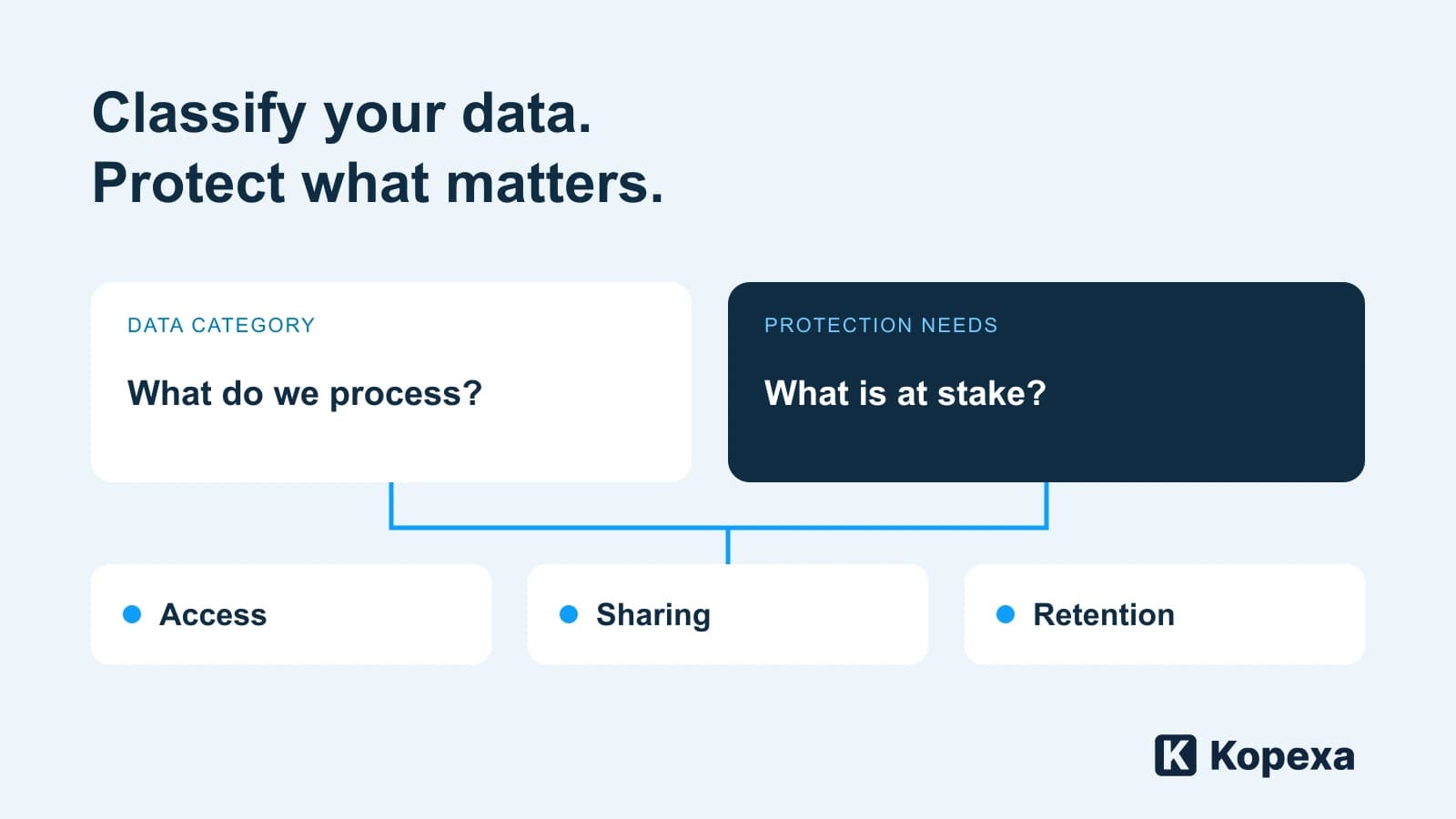

A sickness notification in a team folder, a customer list in a CRM and a bank account in payroll all contain personal data. Yet they do not trigger the same additional legal conditions. Labelling everything “sensitive” does not tell anyone who may access it or how to share it.
This guide helps you classify information and turn that classification into decisions your team can apply.
TL;DR: What is sensitive data?
- Article 9 GDPR protects special categories of personal data, including health information, political opinions and religious beliefs. Processing is prohibited unless a relevant exception applies.
- Bank details, salaries and passwords are not automatically special category data. Their exposure may still cause serious harm. Criminal conviction and offence data is subject to separate Article 10 rules.
- Consent is not always required or appropriate. Identify an Article 6 legal basis and, for special category data, an Article 9 exception.
- Classification must lead to action: decide who needs which information, for what purpose, through which channel and for how long.
Which data needs more protection in your company?
Use the Excel template to decide who may use each data type, how long you retain it and which safeguards are missing. Start with one process, such as HR or customer support. Outstanding reviews show where a decision is needed next. The workbook is in German.
Which personal data receives special protection?
Article 9(1) covers the following categories. Assess the content and processing context, rather than relying on a file name.
| Category | Workplace example |
|---|---|
| Racial or ethnic origin | An identifiable employee survey about ethnicity |
| Political opinions | Recorded political views of an identifiable individual |
| Religious or philosophical beliefs | Religious affiliation recorded in an HR file |
| Trade union membership | A named membership list |
| Genetic data | Results of a genetic examination |
| Biometric data used to uniquely identify someone | A fingerprint template used for access control |
| Health data | Sickness notifications, diagnoses or disability information |
| Sex life or sexual orientation | Such information in counselling or personnel records |
An ordinary portrait is not automatically biometric data covered by Article 9. Technical processing for unique identification, such as facial recognition, changes the assessment. See GDPR, Recital 51.
GDPR also protects personal data outside these categories. It is not restricted to commercial activity, although Article 2(2)(c) excludes purely personal or household activities.
Are bank details and salaries sensitive data?
In everyday language, yes: exposure can cause harm. Legally, neither is a special category merely because it is financial information.
| Record | Classification | Practical decision |
|---|---|---|
| Name and work email | Personal data | Limit use to its purpose and authorised recipients |
| Personal bank account number | Personal data, not inherently Article 9 data | Protect against disclosure and unauthorised changes |
| Payslip | Salary alone is not a special category; other fields may reveal religion | Assess the actual fields |
| Notification that someone is sick | Health data, even without a diagnosis | Restrict access to those who need it |
| Criminal record certificate | Separate Article 10 conditions | Check the applicable legal authorisation |
| Engineering drawing without personal information | Outside GDPR's personal-data scope | Assess confidentiality and business impact separately |
Combinations matter. Transaction information may reveal trade union membership. Ask what the record discloses about a person, not just what the field is called.
Legal category and protection need are separate assessments. A confidential design may be more critical to the business than a publicly available contact address. Consider confidentiality, integrity and availability as part of your information security work.
When can special category data be processed?
You need an Article 6 basis and a relevant Article 9(2) exception. A contract or legitimate interest alone does not lift Article 9's prohibition. Exceptions include explicit consent, specified employment and social-security purposes, legal claims and certain healthcare or public-health purposes. Each has its own conditions; these are not interchangeable justifications.
Document the rule supporting your specific purpose. GDPR applies in Germany and Austria, but national employment and healthcare rules may impose additional requirements. See Articles 6 and 9 GDPR.
Does explicit consent always require a signature?
No. Explicit consent does not invariably require a signed document. The EDPB also recognises other express statements, including oral statements. You must be able to demonstrate valid consent and check any specific legal form requirements. EDPB Guidelines 05/2020, paragraphs 93–95
Consent does not fix an insecure system. It does not make a publicly shared folder appropriate for health records.
Five decisions that make protection practical
Start with one process, such as receiving sickness notifications or exchanging client records. Trace the information from collection to deletion. This workflow translates the principles of Articles 5, 25 and 32 into team decisions.
1. Define what the task actually needs
What decision will someone make using this information? Staff scheduling may require an absence notification, not a diagnosis. Avoid free-text fields that encourage unnecessary details.
2. Identify locations and recipients
Include the business application, mailbox, exports, shared folders and service providers. Assign a process owner. Check processors and any international transfers. A cloud contract does not replace minimisation or appropriate access rights.
3. Grant access by task
Define which role needs which fields. Review shared accounts, external links and former employees' permissions. Strong authentication for privileged access and traceable administrative changes are useful safeguards. Their adequacy depends on the risk.
4. Test a real scenario
Can a substitute complete the task without opening the entire personnel file? Can an external recipient still access a link after it expires? Record the result, owner and next review trigger. Our guide explains how to keep ISMS evidence current and verifiable.
5. Set retention and deletion rules
Decide when the purpose ends and which retention obligations remain. Sensitive data has no single universal deletion period. Include copies, exports and backups: removing a record from the primary application does not remove every copy. Article 17 sets out erasure rights and exceptions.
Can sensitive data be sent by email?
There is no universal ban. Protection must match the risk. Germany's Data Protection Conference distinguishes transport encryption from end-to-end encryption. If email cannot provide adequate protection, use another channel. DSK guidance
Before sending, check whether the full file is needed, confirm the recipient's identity and authority, assess protection and limit subsequent availability. An access-controlled portal can help, but only if configured correctly. Subject lines can also disclose sensitive information.
What happens when you connect ChatGPT or Claude to a mailbox?
An assistant is meant to summarise customer emails. The same mailbox contains applications, sick notes and confidential contracts. The key question is: Which messages does the service need, and which can it access?
Retrieving, searching and summarising personal data are processing operations. This remains true without manual copying and when data is not used for model training. Technical permission does not replace your legal basis or additional conditions required for health data.
Four questions before connecting
- What scope is necessary? Check the specific connector’s permissions, synchronisation and storage. Read-only access does not mean no data is transferred. If the necessary restriction is unavailable, a separate mailbox or deliberately selected extract may be more appropriate.
- What role does the provider have? Processing on your instructions may constitute processing on behalf of a controller and require an Article 28 agreement. The provider’s own purposes need separate assessment. A processor is not automatically a “third party” under GDPR Article 4(10). Also assess subprocessors and international transfers.
- What remains stored? Establish retention, chat history, indexes and deletion after disconnecting. OpenAI explicitly distinguishes disconnecting a Google app from existing chats or memories. Removing a connection therefore does not automatically delete all content. OpenAI: Google app data
- What can the assistant trigger? Summarising differs from sending a reply independently or deciding an applicant’s outcome. Automated processing alone does not trigger GDPR Article 22. That provision concerns, in particular, solely automated decisions with legal or similarly significant effects.
Document purpose, recipients and safeguards in your processing record. Assess DPIA requirements where high risk is likely. The German Data Protection Conference recommends assessing purpose, legal basis and conditions of AI use.
“Our data is not used for training” is one check, not a complete privacy assessment. Examine the actual data flow of your service and plan.
Example: One sickness notification, three teams
HR receives a sickness notification. A manager needs information for cover planning. Payroll needs the information required for its own task. A shared folder for all three creates unnecessarily broad access.
| Step | Decision | Evidence to check |
|---|---|---|
| HR receives the notification | Restricted storage and access | Storage permission test |
| Manager arranges cover | Share only necessary planning information | Role and field visibility check |
| Payroll processes the case | Use the intended transfer channel | Transfer workflow check |
| Retention ends | Delete according to applicable rules and exceptions | Recorded deletion run |
Establish the employment-law requirements for your location. The operational objective remains clear: each team receives what it needs, while the full records stay with the appropriate people.
When do you need a DPIA or breach notification?
A data protection impact assessment is required where processing is likely to create a high risk. Article 35 specifically includes large-scale processing of special categories. A single health-data record does not automatically trigger a DPIA; assess context, scale and the supervisory authority's applicable lists.
Article 33 generally requires notification to the authority without undue delay and, where feasible, within 72 hours of awareness, unless the breach is unlikely to create a risk to individuals' rights and freedoms. Under Article 34, likely high risk generally requires communication to affected individuals too, subject to its exceptions. Document breaches even where notification is not required. See Articles 33–35 GDPR.
Turn a classification into an action you can verify
Kopexa helps you record information assets, assess protection needs and manage risks and measures. Evidence belongs to measures, which are mapped to controls. Your team can see the gap, the work addressing it and how implementation is checked.
Start with one process: which information is involved, who needs access and which permission is too broad? Our ISO 27001 and data protection guide explains how the two disciplines work together.
Bring that process to a demo. We will show you how to connect protection needs, risks and measures in Kopexa. You can then explore your workflow in a two-week guided trial. Book a demo.
Sources
- GDPR: Articles 4–10, 17, 25, 28, 32–35 and Recital 51 — European Union [Accessed ]
- Guidelines 05/2020 on consent: paragraphs 93–95 — European Data Protection Board [Accessed ]
- Protecting personal data transmitted by email — German Data Protection Conference [Accessed ]