Opinion
What the LiteLLM incident reveals about secure releases
Why a valid signature is not enough for release approval: verify provenance, restrict administrative exceptions and test recovery. A CTO perspective.
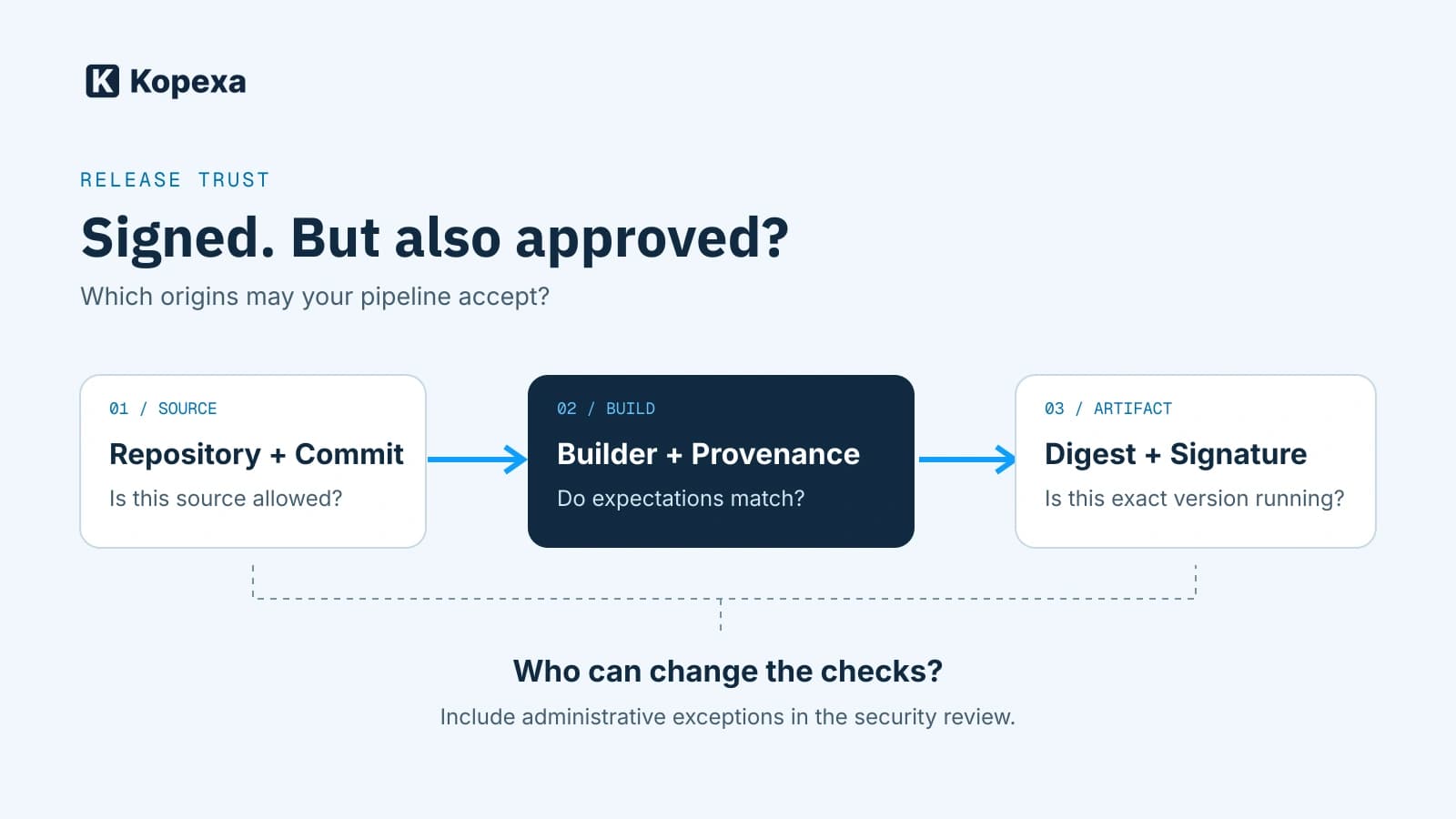

A signed release can contain malware. According to the vendor, that is what happened in this week’s LiteLLM incident. What concerns me is the decision we are actually making when a pipeline reports “signature valid”.
As a technical leader, I want to know: is this really the artifact we intended to approve? Successful cryptographic verification answers only part of that question.
What happened at LiteLLM
On 21 October, LiteLLM reported compromised version 1.107.0. Its final attack-chain report, published on 23 October, corrects earlier assumptions: the starting point was an exposed, unrevoked key for an agent platform. Through it, the attacker obtained a GitHub organisation-owner token and then additional tokens. They bypassed repository protections, redirected the release workflow to another repository and used separate compromised identities to trigger and approve the release. The manipulated artifacts were signed and published; the malicious files were not in the official source tag. Final LiteLLM attack-chain report
For me, that is the crucial difference from an ordinary vulnerability: I also need to examine the connection between reviewed source code, the built package and the running application.
We covered the difficulties of updating old runtimes in our PHP2Shell article. This case poses another question: what if the new package itself is the problem?
What I expect a build to demonstrate
I would tie release approval to specific expectations: which repository is permitted? Which commit was reviewed? Which builder may produce an artifact from it? Does its digest match what is deployed?
A provenance attestation can make that connection verifiable. The receiving side must check its claims against fixed expectations. SLSA describes checks including builder identity, canonical source repository and build parameters. Merely storing an attestation is not enough. SLSA artifact verification
This is also a permissions decision. If the same identity can change the build, relax verification rules and publish, several apparently independent controls depend on one credential.
I would therefore examine administrative exceptions first. Who can bypass branch protection? Who can authorise another publisher? Who changes the rules for accepting a deployment? And where is that change visible if the normal pipeline itself is affected?
The cost of stricter approvals
Additional approvals take time. A small team cannot assign three people to every action. A blocked release can itself become a problem during a security incident.
My priority would therefore be to protect changes to the trust model: new source repositories, altered release workflows, additional publishing permissions and exceptions to verification rules. An ordinary content change needs different treatment from permission to publish arbitrary code in future.
An emergency path belongs in the plan too. I would require time-limited approval, a named owner and a subsequent review. A permanently privileged emergency account merely moves the problem.
These measures do not automatically make a build secure. They limit which changes one compromised identity can make unnoticed. That is the boundary I want to be able to trace.
A practical test for the next technical review
Take a container recently deployed to production. Trace its digest back to the build and approved commit. Then, in an isolated test environment, check whether provenance verification rejects a deliberately unexpected source repository. A harmless test artifact is sufficient; production protections need not be disabled.
Record three results:
- Which check actually rejected the unexpected source?
- Which identity could change or bypass that check?
- Who would notice that change outside the affected release run?
If only a policy knows the correct answer, technical evidence is still missing. If an administrator can bypass everything, that is a concrete architectural decision whose risk someone must own.
This is where I see GRC’s value. In Kopexa, evidence is attached to measures, and measures are mapped to Controls. For this case, relevant evidence would be an actual test result with scope and date. Documented intent alone says little about whether an unexpected artifact would be stopped today.
Recovery is part of the decision too
Railway illustrates another part of the problem. In its preliminary report dated 22 October, it describes interrupted builds while customer applications continued running. Its 23 October guidance explains that commits pushed during the interruption were not queued for later deployment; some connections and credentials may need renewing. Railway report, resuming deployments
For my recovery test, that means I want both a reachable application and a working, trustworthy path for the next change. A verified deployment state is part of that.
My review question after this week is therefore: can we demonstrate where the running artifact came from—and who could override that provenance check?
Updated on 24 October 2026 using the vendor’s final report dated 23 October. The assessment of release trust protections remains our analysis.
Sources
- LiteLLM Incident Report — LiteLLM [Accessed ]
- Build: Verifying artifacts — SLSA [Accessed ]
- Preliminary Report: Oct 21st Security Incident — Railway [Accessed ]
- Recover Failing Deploys — Railway [Accessed ]
- The attack chain behind the v1.107.0 LiteLLM release — LiteLLM () [Accessed ]