Guide
DPIA: When you need one and how to carry it out
Assess whether you need a data protection impact assessment. Includes a worked example, GDPR Article 35 requirements and a German Excel template.
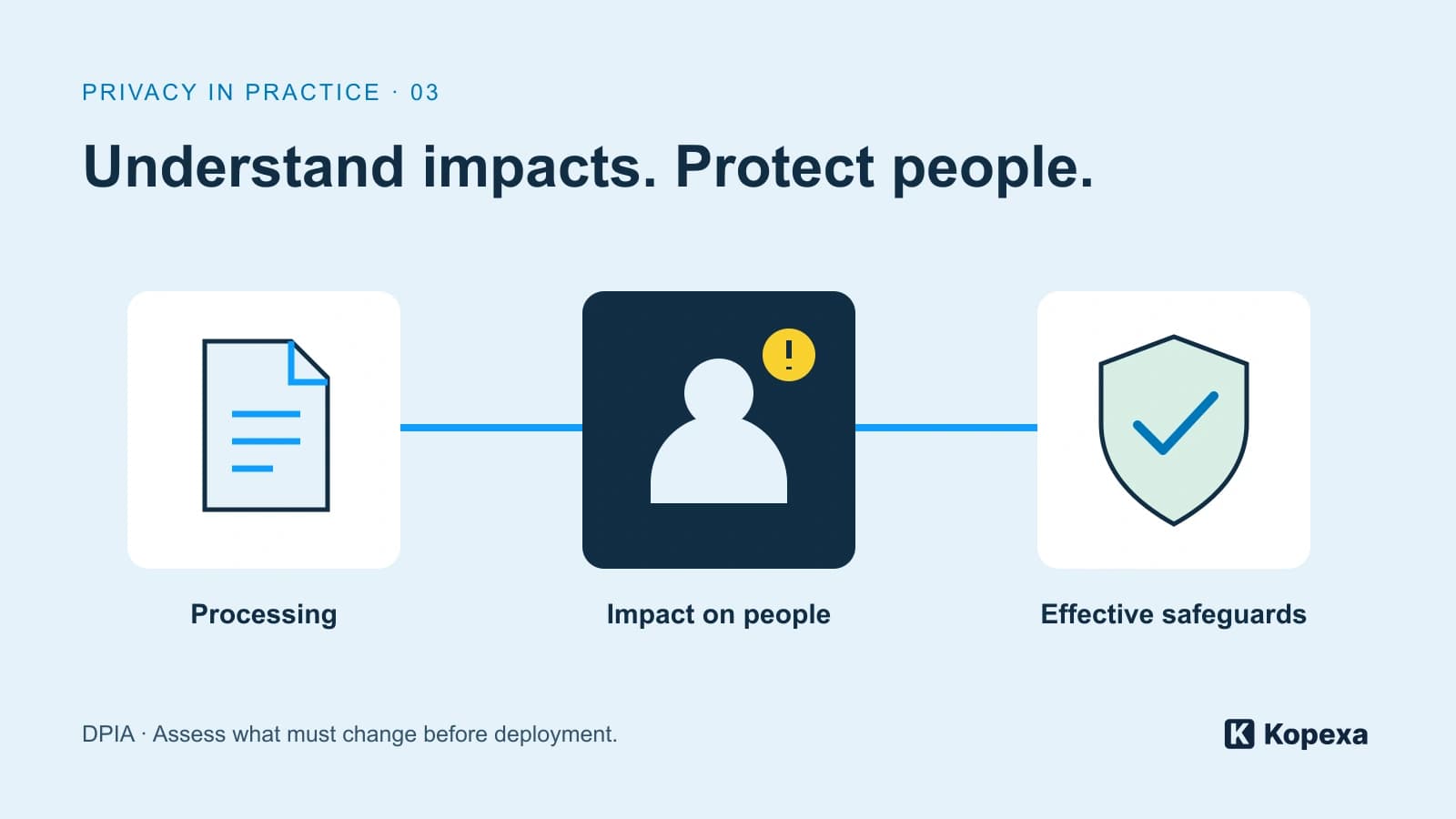

A new tool will shortlist job applicants. It assesses CVs and recommends who gets an interview. Procurement has reviewed the supplier; IT has secured access. One question remains: what happens to applicants if that assessment is wrong, opaque or discriminatory?
A data protection impact assessment (DPIA) addresses those consequences before deployment. It helps you improve the processing and make a reasoned decision. This guide takes you from initial screening to handling residual risks. The accompanying German template provides the working structure.
TL;DR: When do you need a DPIA?
- When processing is likely to create a high risk for people. Nature, scope, context and purpose matter, not employee count.
- Before processing begins. Involve privacy specialists early in procurement and product development.
- A processing register and a DPIA serve different purposes. The register describes activities. The DPIA examines their consequences and safeguards.
- Document the screening decision. Record why a DPIA is not required, too.
- High residual risk needs more than an internal signature. If it cannot be sufficiently reduced, consult the supervisory authority before processing.
DPIA template: Turn screening into concrete safeguards
Use the German Excel template to examine a processing operation together. Instructions sit beside the input fields. Record necessity, purpose and alternatives, assess risks to people and assign safeguards. A worked applicant-ranking example distinguishes a technical weakness from its consequences for people.
Understand the activity before checking the DPIA requirement
Start with the relevant entry in your record of processing activities. Describe the people, data, purpose, recipients, systems and scale involved. A product label such as “recruiting AI” is not enough. Scheduling interviews differs substantially from assessing people and influencing selection decisions.
The Berlin data protection authority calls for documented screening before the activity starts. Begin with the statutory triggers and the applicable list issued by your supervisory authority. If neither gives an answer, assess the particular case. An activity does not become low-risk merely because it is absent from a list.
Statutory triggers under Article 35(3)
A DPIA is required in particular for:
- Systematic and extensive evaluation of personal aspects based on automated processing, including profiling, where decisions with legal or similarly significant effects are based on that evaluation.
- Large-scale processing of special-category data under Article 9(1) or criminal-conviction and offence data under Article 10.
- Systematic, large-scale monitoring of publicly accessible areas.
There is no universal headcount threshold for “large-scale”. Consider the number and proportion of people, data volume and variety, duration and geographical reach. The relevant authority list can cover further specific cases. Read its complete conditions rather than matching keywords such as “biometrics” or “AI”.
Small businesses, medical practices and SaaS providers
| Situation | What to consider |
|---|---|
| Three-person startup with ordinary customer administration | Team size neither triggers nor exempts it from a DPIA. Assess the processing. |
| Individual physician with ordinary patient administration | Health data does not automatically mean large-scale processing. Particular procedures can still require a DPIA. |
| Platform combining health data from many institutions | Assess the overall scope and purpose. A small operator can run high-risk processing. |
| Company using automated applicant ranking | Examine the scoring logic, effect on selection, vulnerability and transparency. |
A medical practice's processing register and its DPIA requirement therefore need separate assessments. Our sensitive personal data guide explains data categories. The DPIA adds the question of what the processing can do to people.
Why a checklist cannot make the decision
The European guidelines identify indicators including evaluation, monitoring, sensitive data, large scale, vulnerable people, dataset matching and new technology. Meeting two criteria is often a strong indicator; one may be sufficient. Simply counting ticks misses the particular circumstances.
For each relevant indicator, record what applies, what supports the assessment and which information is missing. The outcome is “carry out a DPIA”, “not required, with reasons” or “clarification pending”. An unanswered question is not approval.
What must a DPIA contain?
Article 35(7) specifies four minimum elements. The GDPR does not prescribe a particular spreadsheet or official layout.
| Element | Key question |
|---|---|
| Systematic description of processing and purposes, including legitimate interests where applicable | What happens to which data, by whom and why? |
| Necessity and proportionality | Are these data and this interference necessary to achieve the purpose? |
| Risks to rights and freedoms | What harm could people suffer, how severe would it be and how likely is it? |
| Planned measures, safeguards and security mechanisms | How will we address risk and demonstrate GDPR compliance? |
A usable working record also identifies owners, evidence, advice, decisions and review triggers. Seek advice from the designated data protection officer. Where appropriate, seek the views of affected people or their representatives on the intended processing. Record how their input was handled.
How to carry out the assessment
1. Define purpose and data flows
Follow information from collection through deletion. Reference the process, information assets, suppliers and documents already recorded in your processing register. Check the actual steps with the operational team. “The supplier handles it” explains neither access nor purpose.
2. Examine necessity and alternatives
For applicant ranking, secure operation is only part of the question. Is a score needed at all? Could structured human review achieve the purpose? Which data can be omitted? What explanations, corrections and complaint routes are available to applicants?
Document the legal basis and any additional applicable requirements. A DPIA does not create a legal basis or cure unlawful processing. Human involvement is meaningful only when people can actually review and change the assessment.
3. Describe harm from the affected person's perspective
Go beyond “data breach”. Describe cause, event and consequence. For example: an overly broad role lets recruiters access unrelated applications. Confidential information can reach uninvolved people, exposing applicants to disadvantage or loss of control.
A technically reliable system can also create risk: an unsuitable scoring criterion may systematically disadvantage people. Assess fairness, transparency and the exercise of rights alongside confidentiality and availability. Lost revenue or a fine for the company is not the yardstick for this assessment.
4. Specify measures, effects and evidence
A measure needs an owner, a deadline and a verifiable result. “Restrict access” becomes: limit roles to the relevant selection team, test them using test accounts and record the result.
Reassess risk using measures that actually work. A planned test is not evidence of effectiveness. The template separates the initial assessment, safeguards and residual risk. Explain the classification rather than deriving it from a supposedly statutory spreadsheet threshold.
5. Document the decision and next review
The controller makes the decision based on the findings. Data protection officers advise; they do not take over the organisation's responsibility. Processors provide the information and assistance needed for their services.
If high risk remains despite safeguards, consult the competent authority before processing. Internal risk acceptance does not replace this procedure. The Saxony authority explains prior consultation.
Review the DPIA when risk changes: new data sources, additional purposes, different recipients or revised scoring logic can trigger that review. Also set a review date suited to the activity. The GDPR does not impose a universal annual expiry date.
Example: Review applicant ranking before deployment
A company plans to have a supplier assess CVs. The score will determine the order of interviews. After screening, the team decides to carry out a DPIA.
| Open question | Possible consequence for applicants | Next step |
|---|---|---|
| Which features affect the score? | Unsuitable features can distort interview opportunities. | Obtain feature descriptions and tests; examine relevance and disadvantage. |
| Can people meaningfully override recommendations? | An unchallenged score can effectively determine selection. | Give reviewers authority, time and supporting information. |
| Who can export data? | Applications may reach unintended recipients. | Restrict and test export permissions; retain results. |
| Does the supplier use data for its own purposes? | Applicants lose control over additional uses. | Clarify contracts and actual flows; exclude unresolved uses before deployment. |
The example remains undecided until these questions have been examined. The outcome could be a changed use, such as support without ranking people, or a decision against the proposed processing. That is why assessment belongs before procurement is complete.
Which official examples are useful?
The BayLfD provides modules for describing processing, screening and assessment reports. These target Bavarian public bodies. Their structure is useful, but their specific legal requirements should not be applied indiscriminately to businesses.
The CNIL provides methodology and templates. The BayLDA's telematics insurance example illustrates a German assessment. This older example explains a method; it is not current blanket approval for other products.
Reuse existing work instead of creating another privacy silo
A DPIA needs information that procurement, privacy and security already collect: supplier responses, data flows, information assets and safeguards. Reuse those references while keeping the assessment of consequences for people explicit.
In Kopexa, you connect the processing register, processes and information assets, and organise supplier surveys and measures in the same platform. That reduces the need to reconstruct the starting point from separate lists for each review. The substantive DPIA builds on that foundation.
Quick answers
Frequently Asked Questions
Still have a question? Find the answers here.
Does a three-person startup need a DPIA?
Headcount does not decide. A small business must also carry out a DPIA before processing likely to create high risk. Assess the purpose, nature, scope and context of the operation and document the outcome.
Does every medical practice need a DPIA?
No. Health data alone does not automatically trigger a DPIA. Ordinary processing by an individual physician is not large-scale solely for that reason. Other procedures, a large dataset or additional risk factors can require an assessment. The processing-register obligation is separate.
Can I document a DPIA in Excel?
Yes. The required content under GDPR Article 35(7) and a traceable assessment matter. The German template supports documentation; you still need to examine the specific processing.
Who is responsible for the DPIA?
The GDPR controller is responsible. Operational teams provide information, the designated data protection officer advises and monitors, and processors assist within their obligations.
How often should a DPIA be reviewed?
Where necessary, and at least when the risk associated with the processing changes. Article 35(11) does not set a universal annual interval. Define concrete change triggers and a suitable review date.
What if high residual risk remains?
If you cannot sufficiently mitigate high risk, consult the competent supervisory authority under Article 36 before processing. Internal approval or risk acceptance does not replace consultation.
Sources
- GDPR: Articles 35 and 36 — European Union [Accessed ]
- Data protection impact assessment: necessity and documented screening — Berlin data protection authority [Accessed ]
- DPIA guidelines, WP 248 Rev. 01 — Article 29 Working Party [Accessed ]
- Processing operations requiring a DPIA — German Data Protection Conference [Accessed ]
- Prior consultation where high residual risk remains — Saxony data protection authority [Accessed ]