News
VMware ESX: CVSS 2.7, yet known exploitation
CVE-2026-41709 concerns insufficient VMware ESX logging. Why its new KEV listing matters to patch and risk owners despite the low CVSS score.
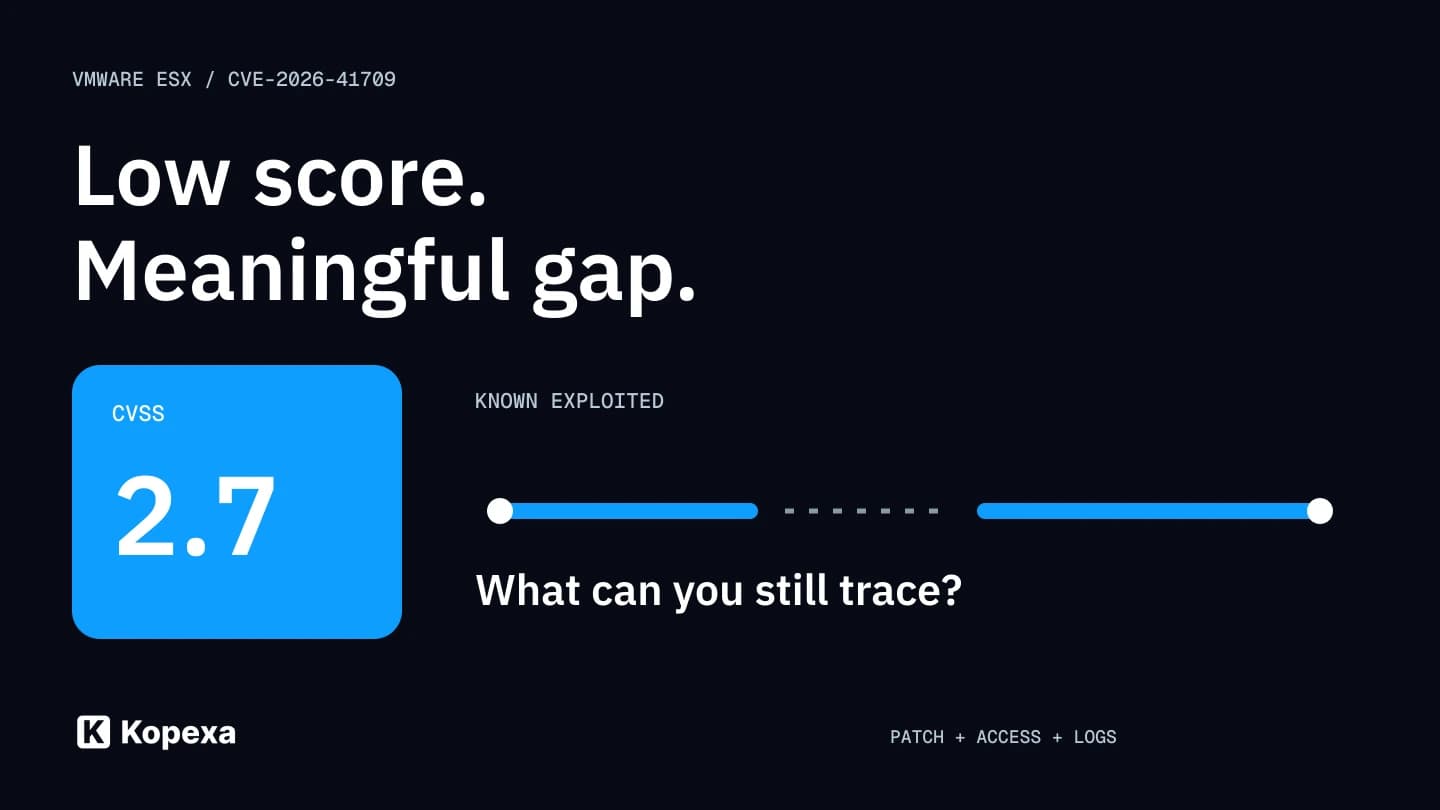

A vulnerability has a CVSS score of 2.7. Can it wait? For CVE-2026-41709, that conclusion misses important context: the VMware ESX issue entered the Known Exploited Vulnerabilities catalog on 28 October.
The Canadian Centre for Cyber Security confirms the CISA KEV addition in its 28 October 2026 update. Known exploitation is the current news. The vendor advisory and security fixes date back to the summer.
Sources checked on 30 October 2026. The operational recommendations below are our assessment for operators and risk owners, not findings about a particular company's environment.
What CVE-2026-41709 allows, and what it does not
Section 3e of Broadcom's VMSA-2026-0006 describes insufficient logging: a malicious administrator can perform certain operations without them being logged. The vendor rates this vulnerability Low, with CVSS 2.7.
Administrative privileges are already required. This CVE describes neither initial unauthorized access nor unauthenticated remote code execution. The public description does not enumerate the specific operations that go unlogged.
The wider advisory contains other vulnerabilities with different severities. Its overall high rating must not be applied to this individual CVE. The description also does not mean all VMware logging stops.
Why a low score can still require action
A technical severity score supports comparison. It does not independently determine what a weakness means for your environment.
A logging weakness also affects investigation: after suspicious administrative access, which actions can still be reconstructed? Where important systems run on the virtualization platform, that uncertainty can matter operationally even though the vulnerability does not itself grant access.
The KEV listing provides an additional exploitation signal. It proves neither that your installation is affected nor a complete attack chain. It does justify revisiting a deferral previously based solely on the CVSS score.
Four questions for the responsible teams
| Question | What you need |
|---|---|
| Are we running an affected version? | The actual running version, mapped to the vendor's response matrix. |
| Has the fix been applied? | Confirmation of execution and the resulting running version. |
| Which administrative access paths exist? | Responsible accounts, permitted access routes and available controls. |
| Which independent evidence sources exist? | Known external log sources, retention and confirmation that events are actually arriving. |
These are separate tasks. Closing a patch ticket does not confirm successful log forwarding. Log forwarding does not replace the security update either.
Broadcom lists no workaround and points to fixed releases in its response matrix. Use that current matrix for the exact product and version mapping rather than copying version numbers from a general news article. For externally operated environments, the provider's confirmation should clearly identify your assets.
Patching does not reconstruct missing events
An update can correct the underlying weakness for subsequent operation. It does not retroactively create a record of an event that was never logged.
If additional indicators suggest unauthorized administrative access, a separate investigation is therefore needed alongside patching. Preserve available findings and involve the responsible incident-response team. Without such indicators, a KEV listing alone is not proof of an incident in your environment.
Our Incident Report helps structure findings, impact and outstanding questions. It replaces neither technical investigation nor case-specific decisions about external notifications.
Make the prioritization decision traceable
Our conclusion is not to disregard every low CVSS score. It is to consider technical severity, known exploitation and the importance of your own systems together.
Document why you are updating or accepting a remaining deadline, who owns the decision and how completion will be verified. In Kopexa, you can connect risk, measure, task and evidence. Your technical operations processes continue to deliver the patches.
Bring a specific vulnerability to a demo: we can use it to show how a prioritization decision becomes traceable tasks and verifiable results.
Quick answers
Frequently Asked Questions
Still have a question? Find the answers here.
Does CVE-2026-41709 allow an unauthenticated attack?
That is not what this CVE describes. Broadcom requires a malicious administrator who can perform certain operations without logging. Administrative privileges must already exist.
Why does a CVSS 2.7 vulnerability matter?
Operational context matters alongside technical severity. Known exploitation and potential gaps in tracing administrative actions can justify reprioritization. They do not automatically establish that your own environment is affected.
Does the update restore missing logs?
No. Updating does not retroactively log an event that was never recorded. Where necessary, independent evidence and additional indicators need separate investigation.
Sources
- VMSA-2026-0006 — Broadcom () [Accessed ]
- VMware security advisory AV26-763, updated 28 October 2026 — Canadian Centre for Cyber Security [Accessed ]